

“Your calculations are wrong,” the boy said quietly.
The millionaire laughed—until he noticed the entire room had fallen silent.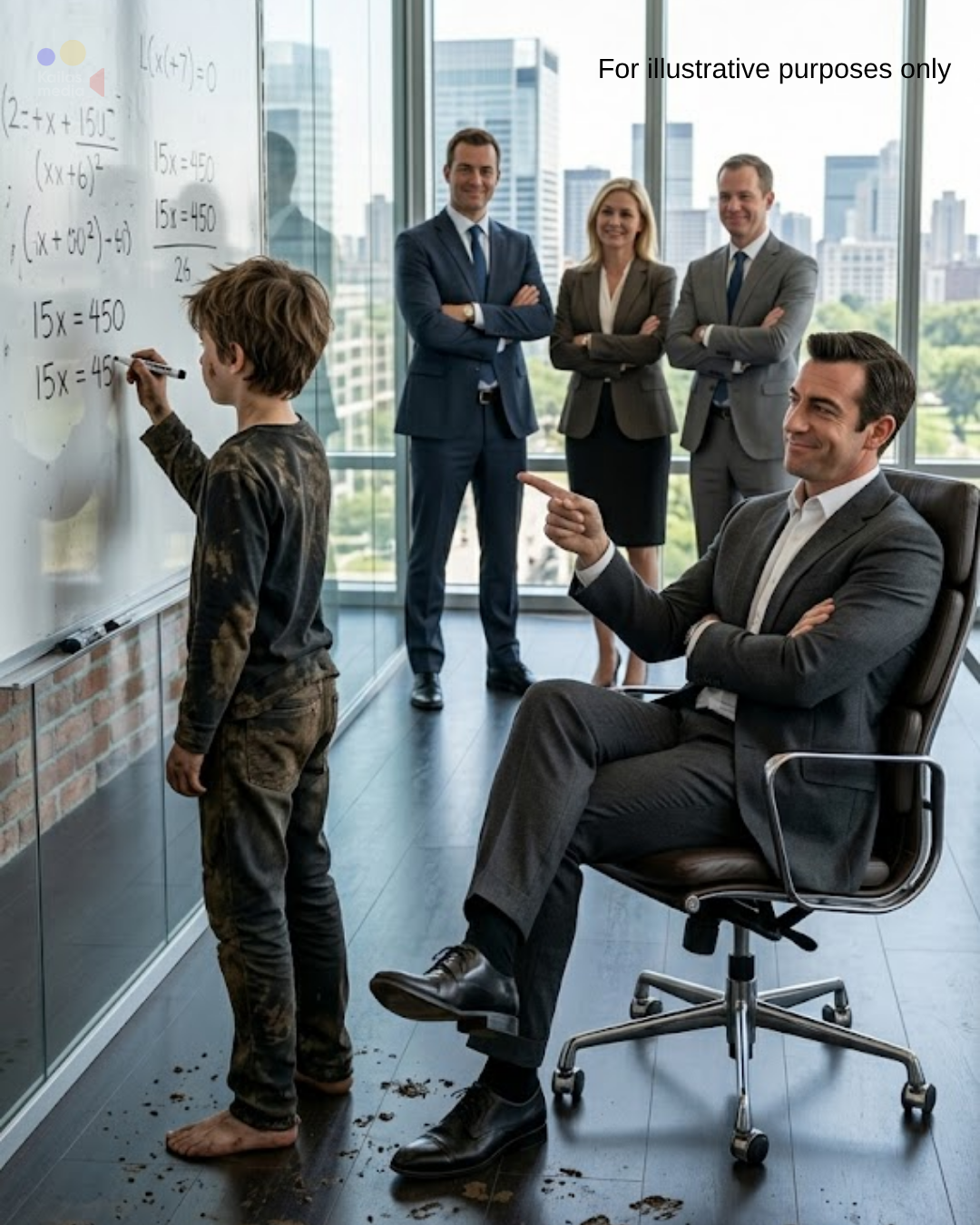
Ethan Caldwell adjusted his tailored tie and glanced back at the whiteboard as though it had betrayed him. The numbers were perfect—or so he thought. Months of preparation had led to this moment inside a glass-walled boardroom overlooking downtown Chicago. This deal would define his future.
“With this expansion,” Ethan said with confidence, pointing at the final figure, “we’re looking at an initial investment of fifty million dollars and a projected return of seventeen percent.”
His assistants nodded. Across the table, three Japanese investors listened attentively. The eldest, Mr. Hiroshi Tanaka, observed quietly, a pen turning slowly between his fingers.
Then the voice came again.
“Your calculations are wrong.”
Ethan turned sharply. Near the door stood a boy—no older than twelve—his thin frame swallowed by a worn backpack. His sneakers were scuffed, and the notebook in his hands looked old and creased.
“Who are you?” Ethan asked, irritation creeping in.
“My name is Lucas Moreno,” the boy replied calmly. “My mom works here. And if you go ahead with those numbers, you’re going to lose a lot of money.”
A few uneasy chuckles spread through the room.
“Do you realize how much this meeting costs?” Ethan said tightly. “We don’t have time for interruptions.”
“It’s not an interruption,” Lucas said, opening his notebook. “You multiplied 127,000 by 394, but you wrote the wrong total. You’re off by a hundred thousand.”
The laughter stopped instantly.
Ethan turned back to the board. His fingers moved quickly across his calculator. The color drained from his face.
Lucas continued, steady and precise. “And in your operating costs, you forgot to include the administrative fee from your earlier draft. I saw it yesterday.”
“How could you possibly know that?” Ethan asked, stunned.
Mr. Tanaka leaned forward slightly. “May we verify?”
They did. Lucas was correct. Again. And again.
“Do you want me to show you the rest?” the boy asked. “There are five more.”
No one laughed now.
Lucas stepped closer, pointing out where compound interest had been mistaken for simple interest, where import costs had been counted twice. Each correction landed with quiet certainty.
“How did you learn this?” Ethan asked, no longer defensive—only amazed.
Lucas shrugged. “I like math. I wait for my mom after work. Across the street there’s a private school. I stand behind a tree and listen through the window.”
That image struck Ethan harder than any error.
Mr. Tanaka examined the notebook carefully. “These calculations are correct,” he said. “Very precise.”
“I don’t know the business terms,” Lucas admitted. “I just know numbers have to make sense.”
Ethan took a slow breath. “Can you help us fix the board?”
Lucas nodded. He erased and rewrote with quiet confidence. When he finished, everything finally aligned.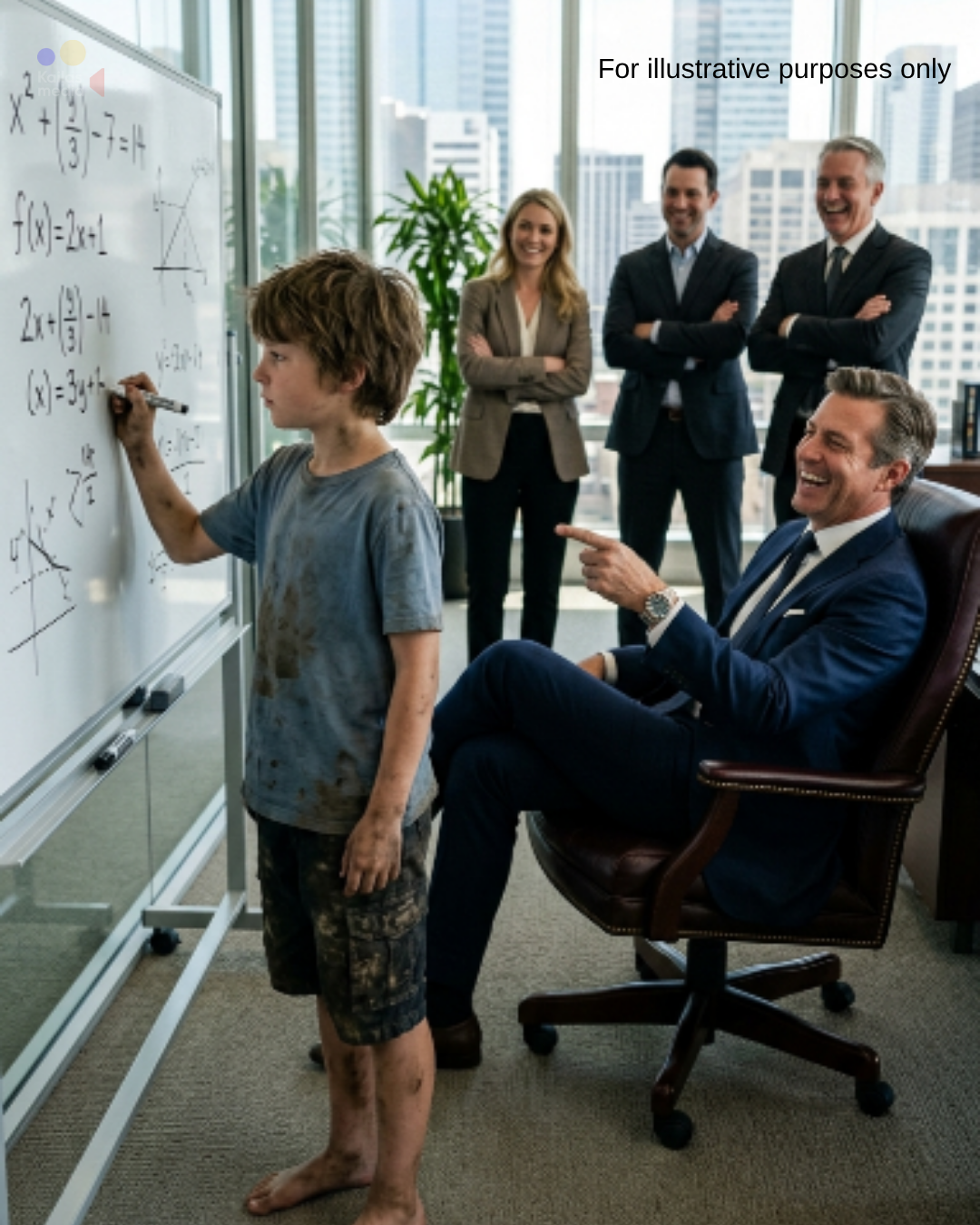
“Excellent,” Mr. Tanaka said. “Now the project is viable.”
Ethan asked to speak with Lucas’s mother. Maria Moreno arrived moments later, visibly nervous.
“Your son helped us today,” Ethan said. “He has an incredible talent.”
“I hope he didn’t cause trouble,” she said softly.
“On the contrary,” Mr. Tanaka replied. “He saved us.”
When Ethan asked about Lucas’s schooling, Maria explained he attended a local public school with limited resources.
Ethan looked out the window and saw the private school across the street—the same one Lucas had been learning from in secret.
“Lucas,” Ethan said, “would you like to study mathematics properly?”
“Yes,” the boy answered carefully. “But my mom can’t afford it.”
“I can,” Ethan said. “No conditions—except you never have to learn from outside again.”
Mr. Tanaka offered to support the scholarship as well.
As they were leaving, Lucas turned back.
“You should also check your shopping center project,” he said. “The land size doesn’t match the map.”
That project was worth over a hundred million dollars.
The next morning, Ethan confirmed it.
Lucas was right—again.
They visited the site. Lucas measured carefully using a tape his mother had given him.
“12,430 square meters,” he said. “Not fifteen thousand.”
The silence that followed was heavy.
But the investors didn’t walk away.
“In Japan,” Mr. Tanaka said, “we respect humility. You listened and corrected your course.”
Lucas began helping review projects—always supervised, always after school.
Weeks turned into months. He studied advanced mathematics with a retired engineer, saved the company millions, and earned quiet respect.
One day, he said to Ethan, “I used to learn from outside. Now I’m inside. But there are still kids behind the tree.”
That stayed with him.
Ethan launched the Open Windows Program to find hidden talent in public schools. Lucas helped mentor other children, telling them, “It’s not magic. Just practice—and asking questions.”
Two years later, the company was stronger—not because it never made mistakes, but because it had learned to listen.
Watching children leave the building with books in their arms, Ethan finally understood something simple.
The greatest thing he had built wasn’t a business.
It was opportunity.
