

The first raindrop touched Helen Carter’s cheek like a warning—cold, sharp—but she kept going.
At seventy, with a weakening heart and a cane tapping against the gravel like a second heartbeat, she walked along the empty road toward the one house she had promised herself she would never beg at. Her breaths were shallow. Her shoes were soaked. Inside her worn canvas bag were hospital papers, a prescription she couldn’t afford, and a few coins that wouldn’t cover even half a meal. Still, she clung to one fragile thought like a prayer: Michael will help me. My boy will help me.
The sky over rural Texas hung low and gray, drizzling over open fields and the long gravel path leading to a tall iron gate. Beyond it stood the kind of house Helen had only ever seen in magazines—white stone, black shutters, gleaming windows reflecting a life she had spent decades trying to build for her son.
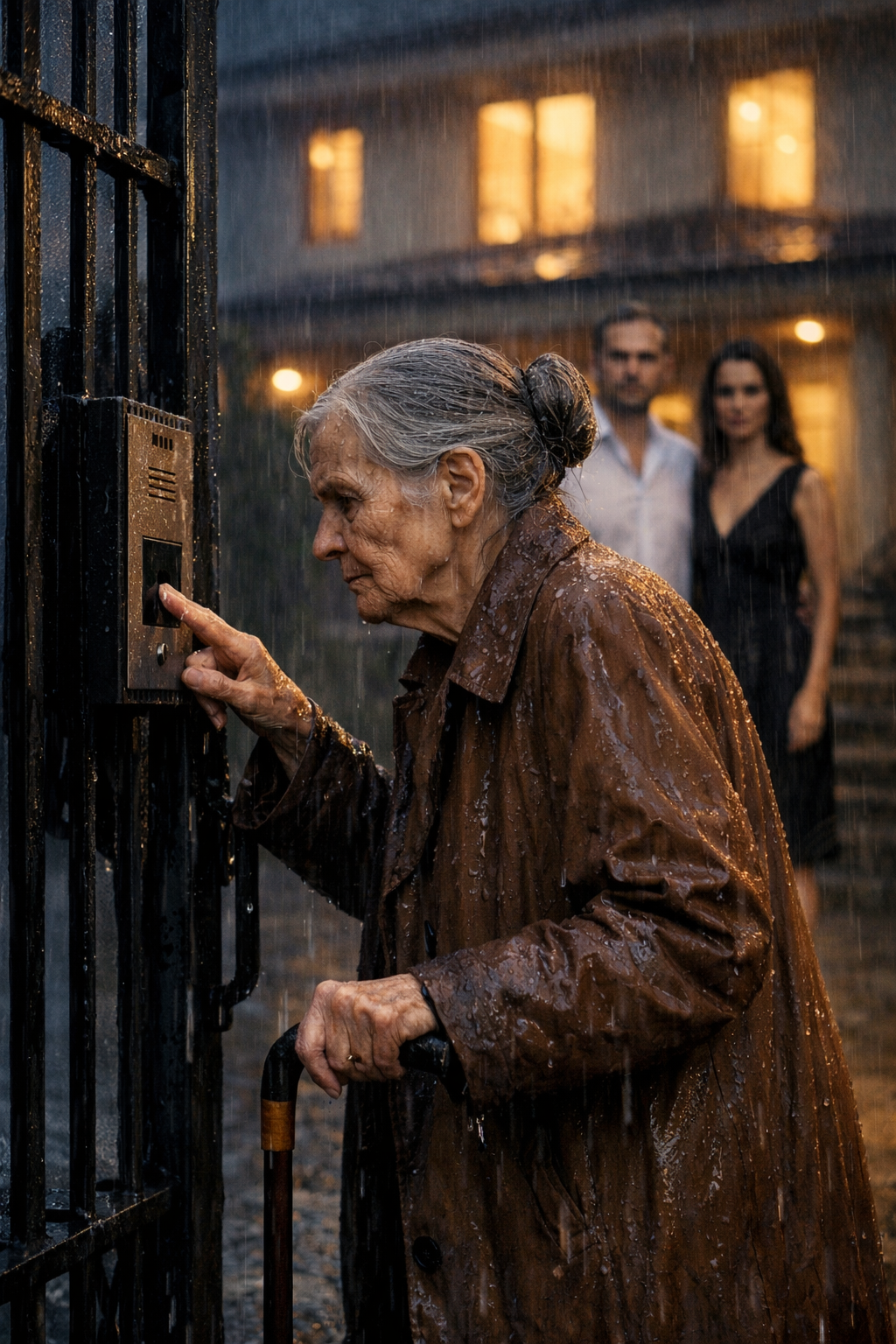
She paused at the gate to catch her breath. Her hand trembled as she reached for the bell.
For a moment, nothing happened.
Then the intercom crackled, and a woman’s voice cut through it like a blade.
“Who is it?”
Helen swallowed. “It’s… Helen.”
A pause.
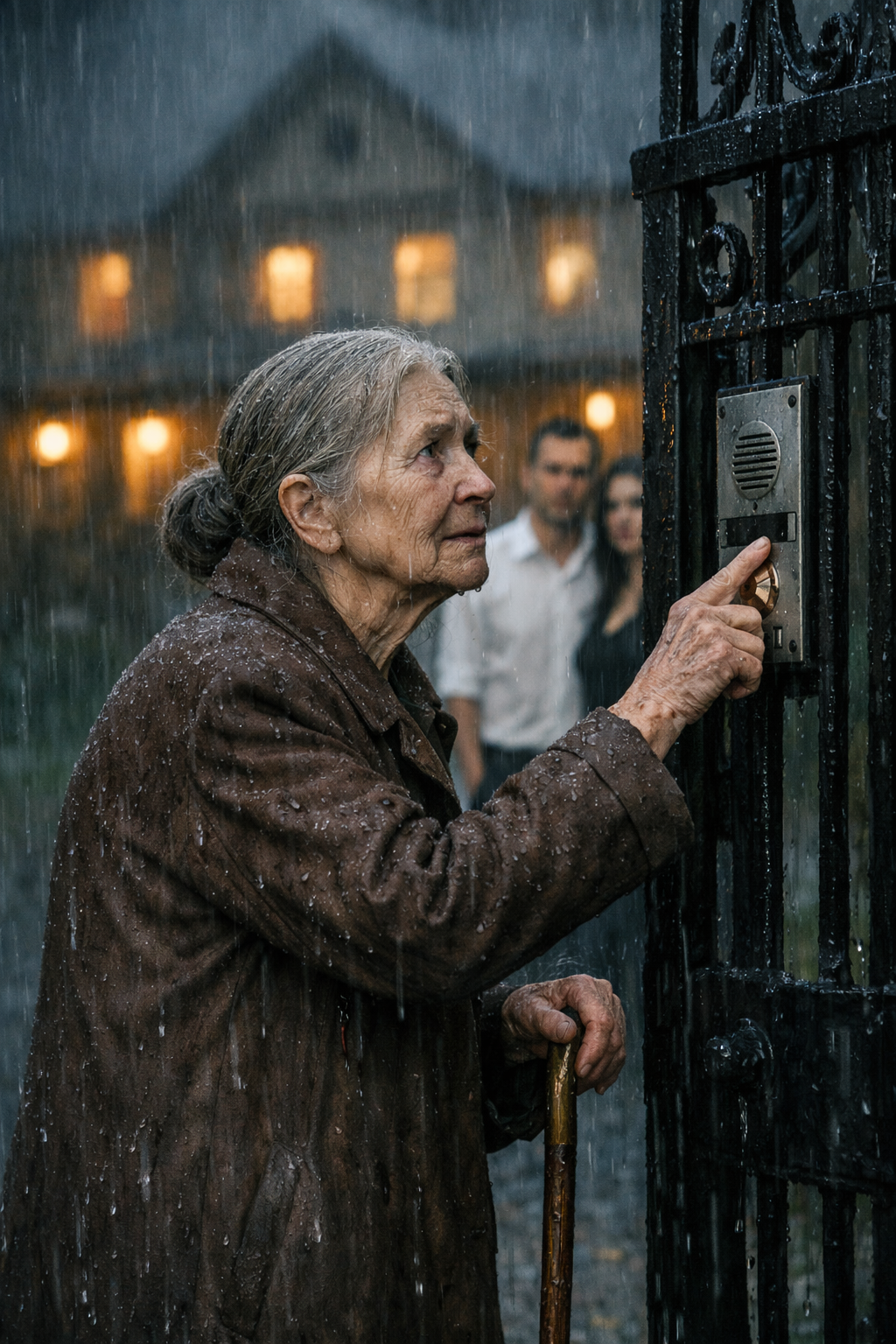
Then the gate buzzed open, and Lauren, Michael’s wife, appeared on the front porch beneath a wide awning. She wore cream silk and gold earrings, flawless and composed, her expression already tightened with irritation. Even from afar, Helen could see it in her eyes—that quiet disgust people reserved for things they wished they could erase.
Lauren folded her arms. “Oh. It’s you. What brings you here, Mrs. Carter?”
Helen forced a small, apologetic smile—the kind mothers wear when they know they’re asking too much.
“I came to see you both,” she said softly. “I… need a little help. For my surgery.”
Lauren glanced back toward the house. “Michael! Your mom’s here.”
A few seconds later, Michael stepped out with a phone in one hand. He seemed taller than Helen remembered—or maybe success had simply added to his presence. Forty years old, clean-cut, expensive watch, pressed shirt, calm face. He looked like a man who signed checks without looking at the numbers.
But when he saw his mother in the rain, something flickered in his eyes—so quickly Helen almost missed it.
“Mom,” he said. “I’m in the middle of something. What’s wrong?”
Helen reached into her bag and unfolded the medical paper with hands so shaky she nearly tore it. “The doctors said I need an operation soon. Heart surgery. I can pay you back when your brother sells his crops. I just need enough to start.”
Michael glanced at the paper, then at Lauren, then away.
He exhaled.
It wasn’t a cruel sigh. That made it worse. It was the sigh of someone who had already made up his mind.
“Mom,” he said, tone measured, controlled, almost distant, “business is tight right now. Things are rough. I’ll send something later.”
For a moment, Helen simply stared at him, as if she had heard the wrong name.
Then Michael did something even stranger.
He turned, opened the trunk of his car, searched briefly, and came back holding a pack of instant noodles.
He placed it in her hands.
“Take this for now,” he said. “Don’t worry. I’ll help when I can.”
Helen looked down at the noodles. Chicken flavor.
Her throat burned.
Before she could say anything, Michael gently guided her toward the gate. “It’s raining harder. Go home and rest.”
The iron gate shut behind her with a hollow metallic clang that echoed through her bones.
And just like that, she was outside again.
Alone.
Rain slid down her forehead into the deep lines around her mouth. Her fingers tightened around the noodles until the plastic crinkled. For one unbearable moment, the world blurred—not from the rain, but from the tears she refused to let fall.
Yet even then, even with her chest aching and her dignity shattered at her feet, Helen whispered the gentle lie mothers tell themselves to survive.
“He must really be struggling,” she murmured. “At least… he still gave me something.”
By the time she reached her small house, twilight had already swallowed the road. The roof leaked in three places. The wooden floor creaked under every step. Wind slipped through a crack near the back door, carrying the smell of mud and wet grass.
Helen set her bag down carefully and eased herself into a chair, one hand pressed to her chest until the pounding slowed. She was so hungry her hands trembled. So tired her bones felt hollow.
At last, she stood and lit the stove.
The noodles would have to be dinner.
She took out a dented pot, filled it with water, and stared at the packet for a long moment. Michael had always loved instant noodles as a boy. Back when they had nothing, he would grin whenever she managed to buy a pack and say it tasted like a feast.
The memory nearly broke her.
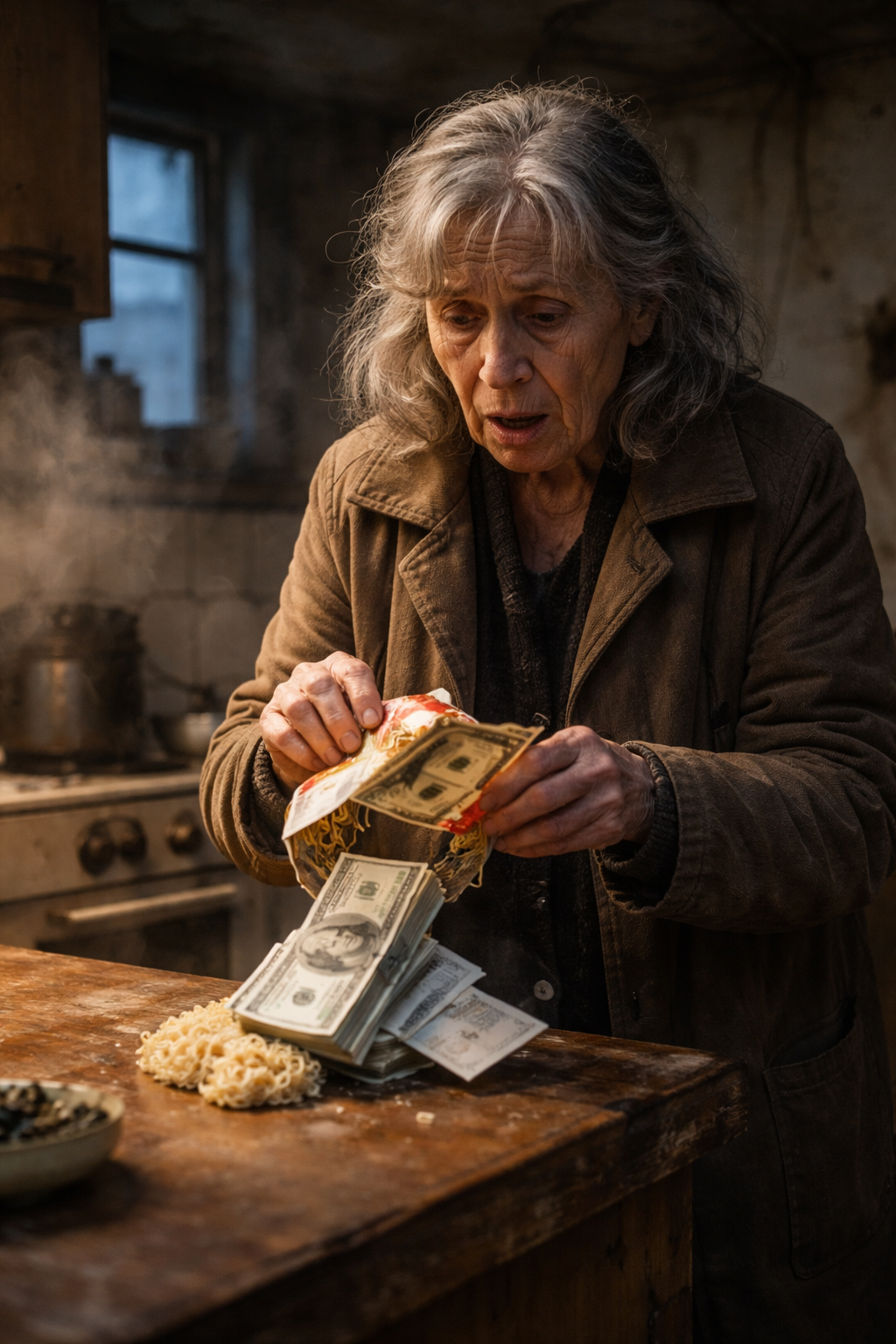
With trembling fingers, she tore the packet open.
Something slipped out.
A small folded bundle hit the counter.
Helen froze.
The kitchen fell silent except for the faint hiss of the stove.
Slowly, she set the packet aside and picked up what had fallen. It was a thick stack of bills wrapped around a note.
Her breath caught sharply, painfully.
She unfolded the note first.
Mom—don’t say anything to Lauren. Don’t call. Don’t trust anyone from the business. Take this money tonight and go to St. Matthew’s Church at 10 p.m. Bring your hospital papers. I’m so sorry. —Michael
For a moment, Helen could only stare. Then her legs gave way, and she sank into the chair, one hand covering her mouth.
The money trembled in her lap.
It was more money than she had held in years.
And suddenly, the cold expression her son wore at the gate didn’t seem cold at all.
It looked like fear.
At nine-thirty, wrapped tightly in her old coat, Helen walked through the rain toward St. Matthew’s Church—a small brick chapel at the edge of town with a crooked steeple and a parking lot half overtaken by weeds. The town clock groaned ten as she climbed the steps.
Michael stood waiting beneath the awning.
The moment he saw her, the mask dropped from his face. He hurried forward, took her arm, and whispered, “Mom, come inside. Quickly.”
The church was dim, lit only by a few flickering candles near the altar. Rain tapped softly against the stained glass.
Helen searched his face. “Michael, what is this? What’s going on?”
He ran a hand through his hair, and for the first time since his father’s funeral, she saw him not as a businessman or a husband, but as her frightened boy.
“Lauren’s father invested in my company two years ago,” he said. “I thought it was a gift. It wasn’t. He’s been using the business to move money—dirty money. I found out three weeks ago. When I tried to get out, they threatened everything. You. Me. The farm.”
Helen’s knees nearly gave out again. “What are you saying?”
“I’m saying I couldn’t give you money in front of her. I couldn’t even let her think I cared tonight. They watch everything. My calls. My accounts. My car. If Lauren suspects I’m moving money to protect you, they’ll come after you first.”
Helen stared at him, dread rising like cold water. “Michael…”
His eyes filled with tears. “I’m sorry. God, Mom, I’m so sorry. Every second you stood there in the rain, I wanted to pull you inside. But if I had… if I had, they would’ve known.”
He reached into his jacket and handed her an envelope.
Inside were hospital documents from a private cardiac center in Dallas—already signed, already paid.
Helen looked up, stunned.
“I sold the business this morning,” Michael said hoarsely. “Everything clean, I liquidated. The money’s under another name. You’ll leave tomorrow before dawn. Pastor Reed will drive you. When you get there, they’ll admit you right away.”
She shook her head, overwhelmed. “You paid for it?”
Michael let out a broken laugh. “Not all of it. I mortgaged the house too.”
Helen stared at him as if she no longer understood the world. “The house?”
“I don’t care about the house.”
She lifted both hands to his face, and the moment her palms touched his cheeks, he broke. The polished, successful man disappeared, and the son she had raised through sacrifice stood before her, crying in the dark.
“I thought you were ashamed of me,” she whispered.
He dropped to his knees before her. “Ashamed? Mom, everything good in me came from you.”
Helen wept then—the deep, quiet kind that comes when something inside both shatters and heals at once. She pulled him close, her thin fingers gripping the back of his coat as if to keep him from slipping away.
But then the church doors burst open.
Lauren stood there, drenched from the rain, her face pale with fury.
Behind her were two men Helen had never seen—broad-shouldered and hard-eyed.
“So this is where you’ve been,” Lauren said softly. Her voice was more chilling than a scream. “Meeting your pathetic mother behind my back.”
Michael stood and moved in front of Helen.
Lauren’s eyes dropped to the envelope in Helen’s hand. Realization flickered—then fury.
“You idiot,” she hissed at Michael. “Do you know what you’ve done?”
“Yes,” he said. His voice trembled, but he didn’t step aside. “I finally did the right thing.”
One of the men moved forward.
Then another voice rang out from the shadows near the altar.
“That’s enough.”
Everyone turned.
From the darkness stepped Sheriff Tom Weller, followed by two deputies and a man in a dark federal jacket.
Lauren froze.
Michael shut his eyes briefly, as if a final weight had lifted.
The federal agent stepped forward, his badge catching the light. “Lauren Whitmore, Daniel Whitmore’s associates, you are under arrest for conspiracy, money laundering, extortion, and attempted witness intimidation.”
Helen stared at Michael, stunned.
He swallowed. “I told them everything, Mom. Weeks ago. The sale, the accounts, the threats. Tonight was the handoff. I needed them to catch Lauren hearing it herself.”
Lauren’s lips parted in disbelief. “You set me up?”
Michael’s expression hardened. “No. You set all of us up. I just stopped protecting you.”
The men lunged, but the deputies were faster. Within seconds, handcuffs snapped shut in the candlelit church. Lauren twisted once to glare at Helen, but Helen didn’t look away from that hatred anymore. Not tonight.
The church filled with sirens, shouted commands, and the sound of rain.
And then, suddenly, it was quiet again.
Too quiet.
Michael swayed.
Helen’s heart jumped. “Michael?”
He pressed a hand to his side. When he pulled it away, there was blood.
Not much at first.
Then far too much.
One of Lauren’s men, in the chaos, had managed a quick knife strike before being restrained. Helen hadn’t even seen it happen.
“Michael!” Her scream echoed through the church.
He collapsed onto the front pew as she rushed to him. The red spreading across his shirt looked impossibly bright in the candlelight.
“No, no, no…” Helen’s hands trembled as she pressed against the wound. “Stay with me. Stay with me, baby.”
Michael’s face had gone pale, but his eyes found hers with a strange calm.
“Mom,” he whispered, “listen to me.”
“Don’t you dare.”
His lips curved into the faintest smile. “There’s one more thing.”
Tears blurred her vision. “Please.”
He nodded weakly toward the hospital file in her lap. “Open the last page.”
With shaking hands, Helen pulled the papers apart until a final sealed sheet slipped free.
She unfolded it.
And stopped breathing.
It wasn’t about the surgery.
It was an adoption record.
Michael’s.
But not his.
Hers.
Helen’s name was printed there in black ink, beside a date from forty years ago and the seal of a county office long gone. The file revealed a truth she had never known: Michael had spent months digging into his father’s estate and uncovered proof that Helen was not the poor widow she believed herself to be. She had been switched as an infant after a storm destroyed the rural clinic where she was born. Her biological parents had belonged to one of the wealthiest ranching families in Texas. The legal claim had remained untouched for decades because no one knew she existed.
Attached to the record was another document.
A deed.
Thousands of acres.
Mineral rights.
An estate worth tens of millions.
Helen looked at Michael, overwhelmed with shock. “What is this?”
His voice grew weaker. “It’s yours. It was always yours. Lauren’s father found out before I did. That’s why they targeted me. They wanted control of the claim through my company, through me, through you. I couldn’t tell you until it was safe.”
Helen shook her head desperately. “No. No, I don’t care about that. I care about you.”
His eyes softened. “I know.”
Sirens wailed closer. Footsteps pounded outside. Help was coming.
But Michael lifted his hand weakly and touched hers.
“All your life,” he whispered, each word heavier than the last, “you thought you had nothing to give. But you gave me everything. Tonight… I finally gave something back.”
Then his hand slipped from hers.
“Helen Carter,” the voices came later. “Ma’am. Ma’am, stay with us.”
But Helen barely heard them.
Because the son she had come to beg from had not only paid for her life, exposed a criminal family, and saved her from ruin—
He had placed the truth of her stolen identity into her hands at the very moment she thought she had lost everything.
And as dawn broke over the churchyard and the rain finally faded, Helen sat in the ambulance clutching a bloodstained adoption file, a deed to a lost empire, and the hand of the boy she had once fed with instant noodles.
For the first time in her life, she understood the full, devastating, miraculous truth:
The poorest woman in Texas had never been poor at all.
And the son she believed had given her noodles instead of love—
had hidden a fortune, a rescue, and her real name inside the packet.
