

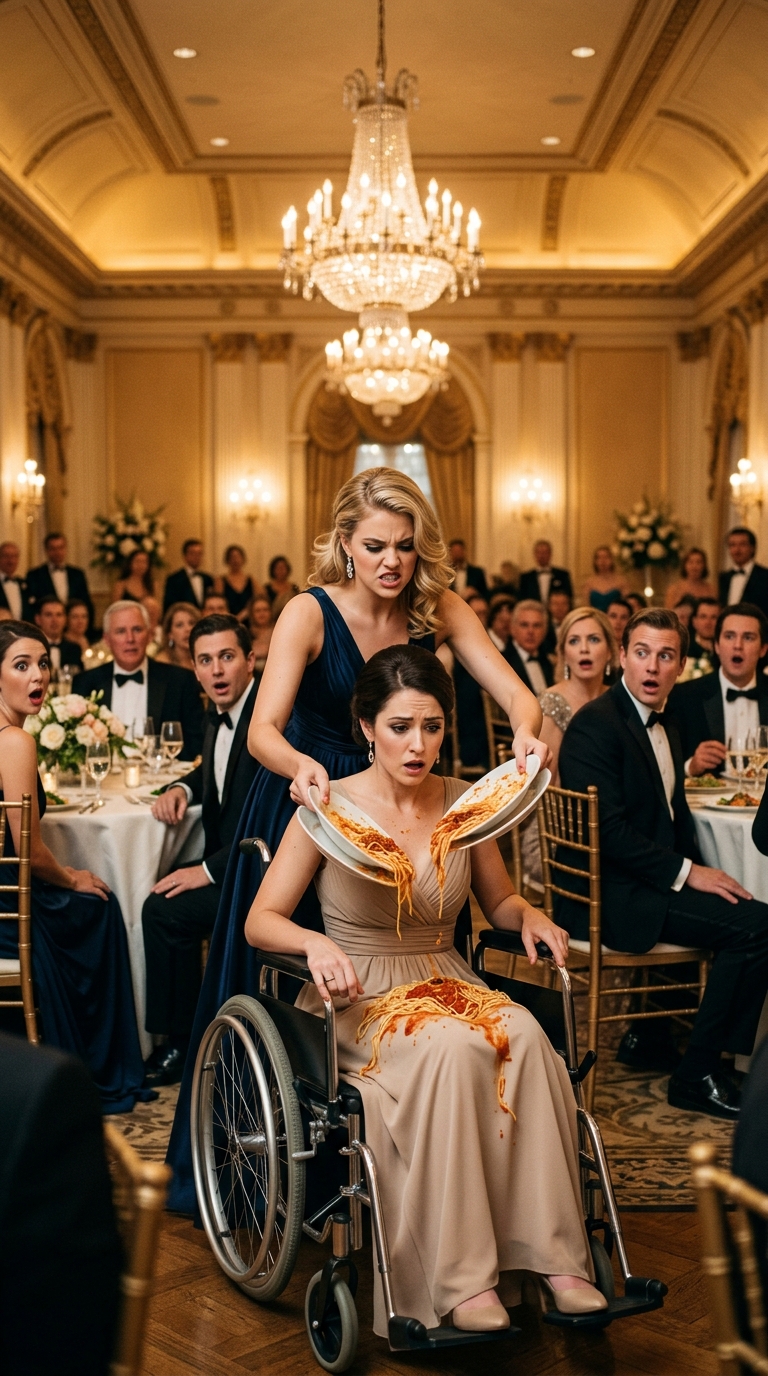
If you came here from Facebook, you’re probably still feeling that knot of anger in your stomach after hearing Vanessa’s words. We left the story at the exact moment the music stopped, and Elena—the girl in the wheelchair—held up a remote control and a legal document in front of everyone. Get ready, because what you’re about to read isn’t just a clever comeback; it’s the legal and financial takedown of someone so arrogant she had no idea who she was dealing with. Welcome to the most expensive lesson in humility ever delivered.
The silence that followed my sudden stop was absolute. The laughter that had filled the marble hall just seconds earlier vanished as if someone had cut off the air. Vanessa was still standing behind me, her hand resting on the back of my chair, but her mocking smile was beginning to falter.
I held the remote in my right hand and the leather folder in my left. My heart was racing—not from fear, but from the adrenaline of justice. For years, Vanessa and her circle of wealthy friends had looked down on me. To them, I was “the cripple,” “the poor girl,” the one who didn’t belong in their world of luxury, vanity, and appearances.
What Vanessa failed to realize—blinded by her ego—was that appearances can be deceiving. She saw a wheelchair; she didn’t see the businesswoman who had inherited and multiplied her grandfather’s real estate empire.
“What are you doing?” Vanessa asked, trying to regain control. “Are you going to change the music? Give it to me.”
She tried to snatch the remote, but I maneuvered my chair smoothly, leaving her hand grasping at nothing.
“No, Vanessa,” I said firmly, projecting the same authority I use in boardrooms. “I’m not changing the music. I’m shutting down your party.”

The Blackout and the Truth About Ownership
I pressed the red button on the smart universal remote.
Instantly, the strobe lights, the high-end sound system, and even the air conditioning shut off. The mansion was left lit only by emergency lights and the moonlight streaming through the tall windows.
“Hey! What’s wrong with you?” one of Vanessa’s friends shouted. “Turn it back on! Vanessa paid to rent this place!”
“Exactly,” I said, turning my chair to face everyone. “Vanessa paid to rent it. But it seems she didn’t bother reading the lease agreement.”
I dropped the folder onto the glass coffee table. The sharp sound of leather hitting glass made everyone flinch.
“Rent?” Vanessa let out a nervous laugh. “My dad paid a fortune for this place for my birthday. It’s the most exclusive property in the city. You don’t know anything about this—you probably snuck in through the service entrance.”
“Open it,” I said, nodding toward the folder.
Vanessa, eager to humiliate me one more time, opened it with a dismissive scoff. “Let’s see what nonsense you brought…”
Her eyes scanned the page. First with amusement, then confusion, and finally—pure terror.
At the top of the document, in bold gold letters, it read: “TEMPORARY LEASE AGREEMENT – PROPERTY OF ELENA VILLARREAL REAL ESTATE.”
Vanessa looked up. At me. Back at the paper. Then at my wheelchair. “No… that’s not possible. You’re Elena… the one from school… the one who had nothing…”
“I’m Elena Villarreal,” I corrected calmly. “I am the legal owner of this mansion, the land it stands on, and the company your father had to beg to secure this booking. And you, Vanessa, have just violated the most important clause in my contract.”
Clause 15: Discrimination and Emotional Damages
The atmosphere in the room shifted from party to panic. Guests began whispering among themselves. No one wanted to be on the wrong side of the homeowner.
“What are you talking about?” Vanessa stammered. “We paid. You can’t kick us out. I have rights. I’m calling my lawyer!”
“Go ahead, call him,” I said with a cold smile. “Tell him to read Clause 15, paragraph B: ‘The landlord reserves the right to terminate the agreement immediately and without refund if the tenant or their guests engage in discriminatory, violent, or degrading behavior toward staff, neighbors, or the property owner.’”
I moved my chair toward her, forcing her to step back until she bumped into the drink table.
“You called me ‘disabled.’ You said I was ‘in the way.’ You tried to throw me out of my own house in front of a hundred people. That, dear Vanessa, is direct discrimination against the property owner.”
“It was a joke!” Vanessa shouted, panic rising as her friends began distancing themselves from her. “We were just playing! Elena, please don’t do this!”
“Playing?” I asked. “When you pushed me toward the exit—was that a game? No, Vanessa. That was your true self. And that version of you is about to cost you dearly.”
I pulled out my phone and called the head of security for the residential complex, who had been waiting for my signal outside.
“Ramirez, proceed. The event is over. Immediate eviction.”
Within a minute, ten uniformed security guards entered the hall. These weren’t the private guards Vanessa had hired—they were the luxury complex’s security, men who answered only to the property owner.
“Ladies and gentlemen, please exit the premises,” the head of security said firmly. “The event is over. You have five minutes to clear the area, or we will call the police for trespassing.”

The Financial Twist: The Fine That Ruined the Night
Guests rushed out. No one said goodbye to Vanessa. The same “friends” who had laughed earlier now passed by me quietly, murmuring apologies, terrified of being blacklisted from future social events.
Vanessa stood alone in the middle of the empty dance floor, crying, her mascara smeared.
“Elena… my dad is going to kill me,” she sobbed. “He paid $20,000 for tonight. If you kick us out, he’ll lose the money.”
“Oh, don’t worry about the $20,000,” I said. “That’s the least of your concerns.”
“What do you mean?”
“The contract also includes a penalty for violating conduct policies. That’s an additional $50,000 for damages to the property’s reputation. And since the contract is in your father’s name, the invoice will be delivered first thing tomorrow morning.”
Vanessa collapsed to her knees. Literally. The girl who once looked down on me was now at the level of my wheels, begging.
“I don’t have that kind of money! Elena, please forgive me! I’ll kneel if you want! I’ll kiss your feet! Just don’t charge my father—he’ll disown me!”
I looked at her—not with hatred, but with the kind of pity reserved for someone truly small on the inside.
“Get up,” I said. “I don’t want you kissing my feet. I want you to learn that the world doesn’t revolve around you.”
“Please…” she whimpered.
“The fine will be enforced,” I said firmly. “But I won’t keep it. The $50,000 will be donated in full to a foundation that provides wheelchairs for low-income individuals. So congratulations, Vanessa—your cruelty tonight will help fifty people walk again. At least you were useful for something.”
The Father Arrives—and the Final Humiliation
At that moment, Vanessa’s father stormed into the hall, alerted by the guards outside. He was a businessman—but insignificant compared to my family’s empire.
“What is going on here?” he shouted. “Why are they throwing my daughter out? I paid for this!”
Vanessa ran to him, crying. “Dad, let’s go! Please!”
I approached calmly. “Good evening, Mr. Rivas. I’m Elena Villarreal. Your daughter has violated the contract by discriminating against me in my own home. Security will provide you with the penalty notice.”
Vanessa’s father flushed with embarrassment. He recognized me. He knew who my grandfather was. He knew that crossing the Villarreal family was commercial suicide.
He turned to his daughter with a look of disappointment that hurt more than any slap. “You insulted the owner?” he demanded. “Don Arturo’s granddaughter?”
“I didn’t know…” Vanessa cried.
“You’re an idiot!” he shouted at her in front of me and the guards. “You’ve just destroyed my reputation! Get to the car—now!”
Vanessa was dragged out by her father without looking back. The “queen of the party” left defeated—owing a fortune and losing her social status in a single night.

Conclusion and Final Reflection
The next day, the story spread across the entire city. No one invited Vanessa to any important events again; she became a social outcast, known as “the girl who tried to throw out the owner.”
I went on with my life. I used the money from the fine to purchase sports wheelchairs for the local Paralympic team.
Months later, I ran into Vanessa at a café. She was sitting alone. She saw me walk in, hesitated for a second, lowered her gaze—and quietly left. There were no insults, no mockery. Just the silence of respect learned the hard way.
This story leaves us with a powerful lesson:
Never humiliate anyone, because life is a wheel that is always turning. Today you may be the one on top, dancing—tomorrow you could be the one on the ground, begging.
A wheelchair does not define a person’s worth, nor their power. True disability is not physical—it is mental and emotional. Vanessa could walk perfectly, but her soul was crippled by arrogance. I was seated, yet I stood far above her.
Remember: treat everyone with respect—not because they hold power, but because you do. And be careful who you try to push out of the party… you might be pushing out the owner of your destiny.
If this story of justice moved you, share it. Let’s make one thing go viral: true elegance comes from humility, not money.
