

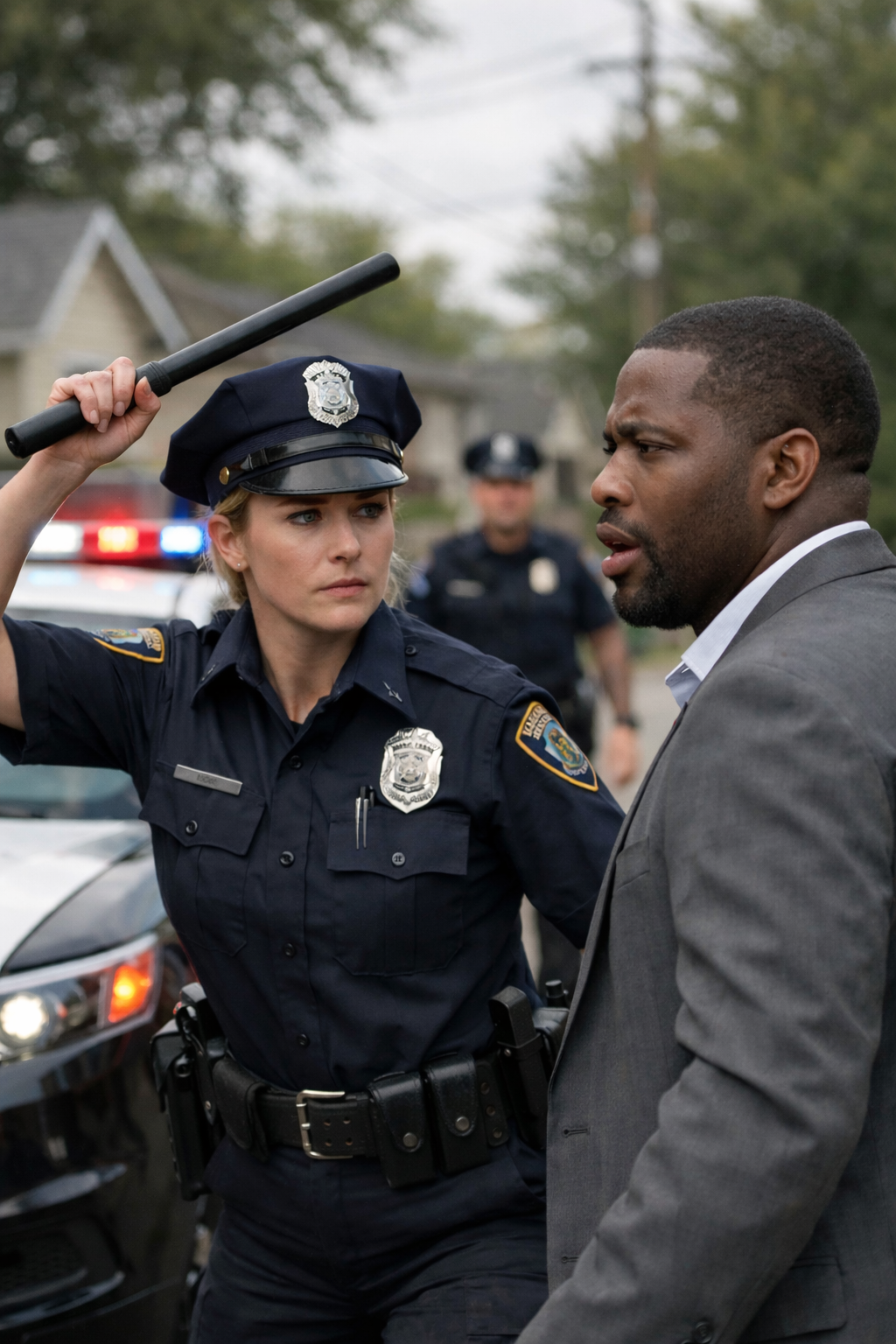
Officer Erin Halstead had spent ten years in Chicago’s 11th District developing the wrong kind of confidence—the kind that grows when complaints vanish into paperwork and the streets reward suspicion over patience. On a damp Thursday night, she cruised past a row of shuttered storefronts when a black Mercedes rolled smoothly through a green light.
It wasn’t speeding. It wasn’t swerving. It simply looked expensive in a place Erin believed didn’t “fit” it.
She flipped on her lights.
The driver pulled over right away. A well-dressed Black man in his late thirties kept both hands on the wheel, calm and composed. His suit was crisp. His voice steady.
“Evening, officer,” he said. “Is there a problem?”
Erin didn’t answer the question—she followed the narrative already in her head. “License and registration.”
“Yes, ma’am.” He reached slowly toward the glove box.
“Stop!” Erin snapped, stepping closer. “Hands where I can see them.”
He froze, palms open. “I’m getting my registration like you asked.”
Erin’s pulse surged—adrenaline, ego, bias all tangled together. “Step out of the vehicle.”
He complied. Rain shimmered on the pavement, reflecting the patrol lights like a warning. A few people at a nearby bus stop watched but didn’t interfere. In this city, you learned to stay out of it.
“What’s your name?” Erin demanded.
“Andre Bishop,” he replied evenly.
Erin smirked. “You live around here, Mr. Bishop?”
“I’m passing through,” he said. “I’d like to know why I was stopped.”
Erin circled him like he was something to inspect. “You fit the description.”
“Of what?” Andre asked calmly. “A man driving his car?”
Erin’s jaw tightened. Calm felt like defiance to her. “Turn around. Hands behind your back.”
Andre raised his eyebrows. “Officer, I haven’t done anything. If this is a misunderstanding, we can—”
“Don’t lecture me,” Erin barked.
When Andre shifted slightly—barely moving—Erin grabbed his arm and shoved him toward the trunk. He stumbled but didn’t swing, didn’t fight—just tried to steady himself.
That was enough for Erin to escalate.
“Resisting!” she shouted, as if saying it made it real.
Her baton came out. One strike to his thigh dropped him to a knee. Another to his shoulder drove him forward. Andre grunted in pain but didn’t retaliate. He raised a hand instinctively—defensive, not aggressive.
Erin twisted his wrist behind him and snapped the cuffs tight.
From the bus stop, someone finally shouted, “He didn’t do anything!”
Erin ignored it. She leaned close to Andre’s ear. “Next time, you answer quicker.”
Andre’s breathing stayed controlled, though strained. “You’re making a mistake,” he said quietly.
Erin let out a short laugh. “People like you always say that.”
She pushed him into the back of her cruiser and called it in: “Suspect detained. Resisted. Requesting transport support.”
At the station, the desk sergeant glanced at Andre, then at the report, then back at Andre—eyes widening.
Andre met Erin’s gaze through the bars and said quietly, “Officer Halstead… you should’ve checked the credentials in my jacket.”
Erin reached into the evidence bag, pulled out a leather ID holder, and flipped it open.
Her face drained of color.
Because the badge didn’t say “civilian.”
It said Deputy Superintendent, Internal Affairs Division—and the name on it was Andre J. Bishop.
What happens when the man you just brutalized is the official newly appointed to oversee your district—and your bodycam has been recording everything?
Part 2
The room didn’t erupt with shouting. It went quiet—worse than shouting.
The desk sergeant, Miguel Alvarez, straightened so quickly his chair squeaked. “Ma’am,” he said carefully, “step over here.”
Erin swallowed. “That’s not—he’s lying.”
Alvarez didn’t blink. “Deputy Superintendent Bishop was sworn in last week. The superintendent circulated his photo.”
Erin glanced back at Andre. Under the harsh station lights, he looked exactly like someone who had no time for games. His shoulder sagged slightly, pain held behind control.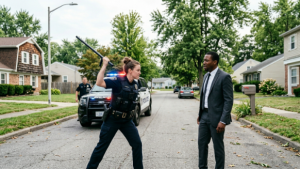
Alvarez picked up the phone. “Get the watch commander down here. Now.”
Within minutes, Lieutenant Carla Jennings arrived with a shift supervisor. One look at Andre’s cuffed wrists and swelling shoulder, and her expression hardened.
“Uncuff him,” Jennings ordered.
Erin reacted instantly. “Lieutenant, he resisted—”
Jennings cut her off. “Officer Halstead. Stop talking.”
Alvarez unlocked the cell. Andre stepped out slowly, wincing. Jennings offered him a chair and water, then turned back to Erin.
“Bodycam,” Jennings said.
Erin hesitated just long enough.
Jennings’ tone sharpened. “Now.”
Erin removed it and placed it on the desk like it weighed everything. The supervisor bagged it immediately.
Andre finally spoke, calm but firm. “I’m going to the hospital. After that, I’m filing a formal complaint, and I expect evidence preservation.”
Jennings nodded. “Yes, sir.”
Erin’s voice cracked slightly. “Sir, I didn’t know who you were.”
Andre met her eyes. “That’s the point, Officer. You didn’t need to know who I was to treat me like a human being.”
At the hospital, doctors documented bruising, a sprain, and injuries consistent with baton strikes. Andre made no dramatic statements. He let the record speak.
By morning, the story was already spreading. A bystander clip circulated—rain, flashing lights, Andre on one knee, Erin shouting “Resisting!” over and over.
The department issued a careful statement: “An incident is under review.”
It didn’t slow anything.
Internal Affairs moved differently. Footage, metadata, reports, history—everything was pulled. And now Andre Bishop led that process.
The first contradiction surfaced quickly. Erin’s report claimed Andre reached for his waistband and attempted to strike. The bodycam showed open hands, slow movements, controlled speech. The dashcam showed a routine stop.
Then came a deeper issue: Erin’s bodycam audio dropped for seconds right after she shouted “Resisting.”
IT called it a glitch—until patterns emerged. Similar drops in past incidents, always after escalation.
Andre’s team reviewed her history: complaints, aggressive stops, repeated targeting patterns.
The case escalated beyond internal discipline. Civil rights units stepped in. Federal attention followed. Erin was no longer just a departmental issue—she was a legal one.
Placed on leave, she leaned on her union.
“Officer Halstead feared for her life,” they claimed.
Andre’s response was simple. “Fear is not a license to fabricate.”
Depositions followed. Andre filed suit for unlawful stop, excessive force, false arrest, and emotional harm. The city attempted a quiet settlement.
Andre refused.
“Quiet settlements teach nothing,” he said. “I want change.”
Under oath, Erin’s reasoning unraveled. No clear cause for the stop. No real description. Just assumptions she couldn’t justify.
By the time the criminal review ended, charges were unavoidable: falsifying a report, unlawful detention, and misuse of force.
The superintendent announced oversight reforms.
Erin watched it unfold from her apartment, blinds closed, phone buzzing with calls she couldn’t answer. Her life unraveled as quickly as the narrative she once controlled.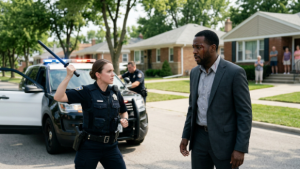
Andre didn’t celebrate. He focused on making sure the case meant something beyond headlines.
And when the city finally agreed to a structured resolution—financial damages and policy reform—Andre added one unexpected condition:
He wanted accountability to extend beyond punishment, if the court allowed it.
Because the real issue wasn’t just what Erin did.
It was whether the system that shaped her could change before it created the next Erin Halstead.
