

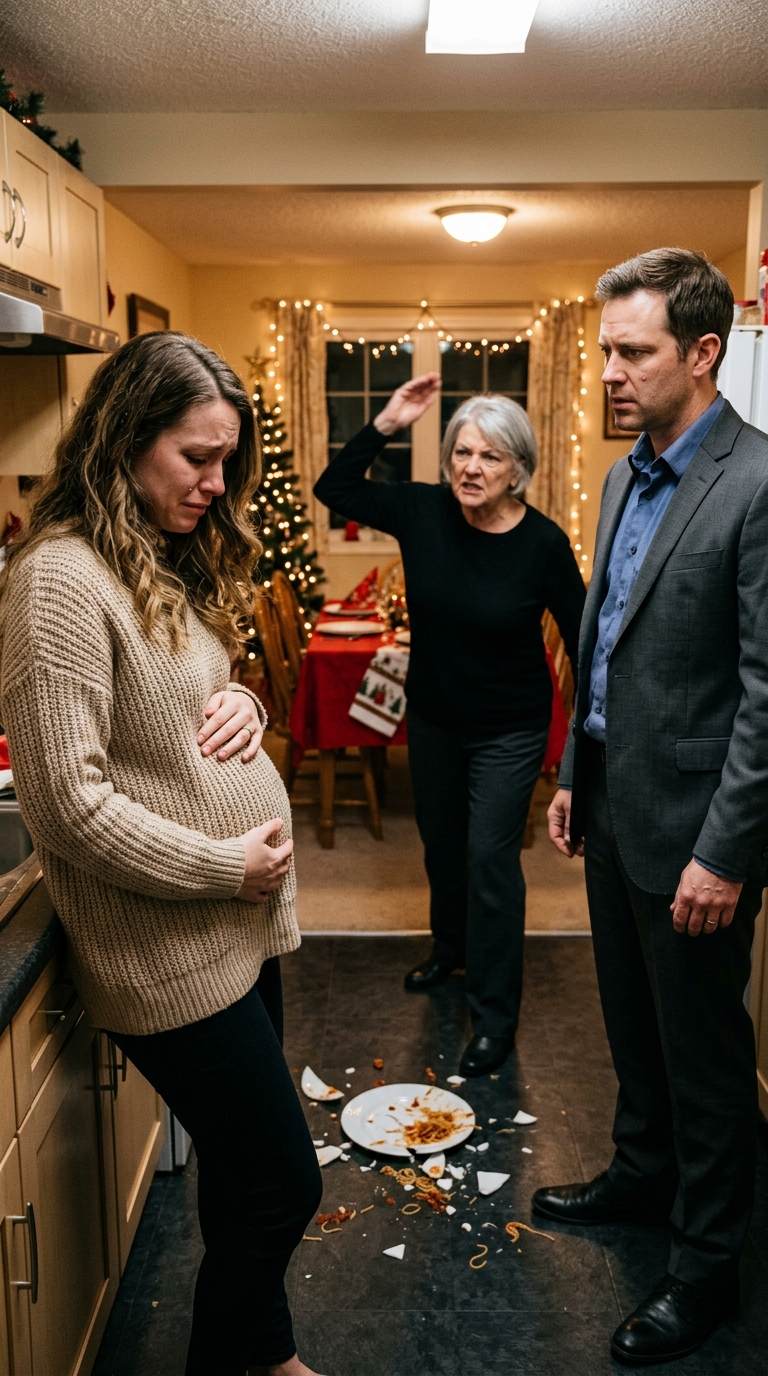
I never told my in-laws who my father was because I wanted a marriage built on love, not influence. When I met Ethan Caldwell, he said he admired my independence. He was a rising attorney in Boston—polished in public, charming at dinner parties, always ready with the right words. His parents, Richard and Linda Caldwell, came from old money and old expectations. Linda, especially, believed respect was something a wife earned through obedience. I learned that slowly… and then all at once.
By the time I was seven months pregnant, I was already drained from pretending their cruelty was normal. Ethan worked late and called it ambition. Linda criticized everything—from the way I folded towels to the way I walked while pregnant—saying women in her generation were stronger and complained less. Richard rarely spoke, but his silence only made space for Linda to dominate every room she entered.
That Christmas, they insisted dinner be hosted at their house and declared it would be “good practice” for me as a mother. I thought that meant helping organize the meal. Instead, when I arrived that morning, Linda handed me an apron and a handwritten menu that could have fed twenty people: turkey, glazed ham, sweet potatoes, green beans, stuffing, pies, rolls, gravy, and three dishes she called “family tradition.” She sat in the dining room with tea while I stood for hours in a hot kitchen, my back aching, my ankles swollen, my baby pressing heavily under my ribs.
I asked Ethan for help twice. The first time, he kissed my forehead and said, “Just get through today.” The second time, he lowered his voice and warned me not to embarrass him in front of his parents.
By dinner, my hands were trembling. Everyone sat at the table except me. Linda told me I should eat standing in the kitchen because “sitting too much makes labor harder,” adding that discomfort was “good for the baby.” I was too exhausted to argue. I made a plate and leaned against the counter, trying to breathe through a wave of pain that felt different from anything before.
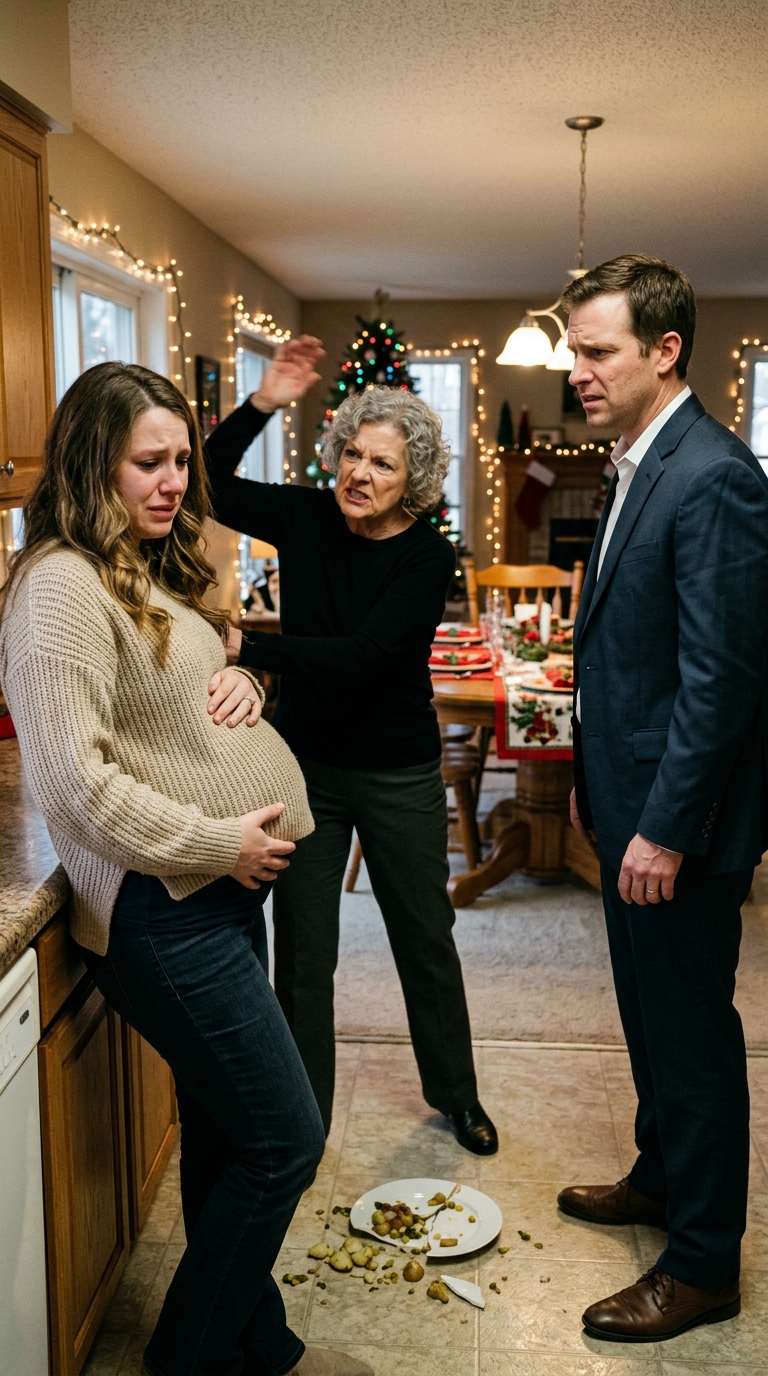
When I finally carried my plate toward a chair in the breakfast nook, Linda stepped in front of me. I said quietly, “I need to sit down.” She snapped that I was being dramatic. I moved past her anyway.
That was when she shoved me.
Hard.
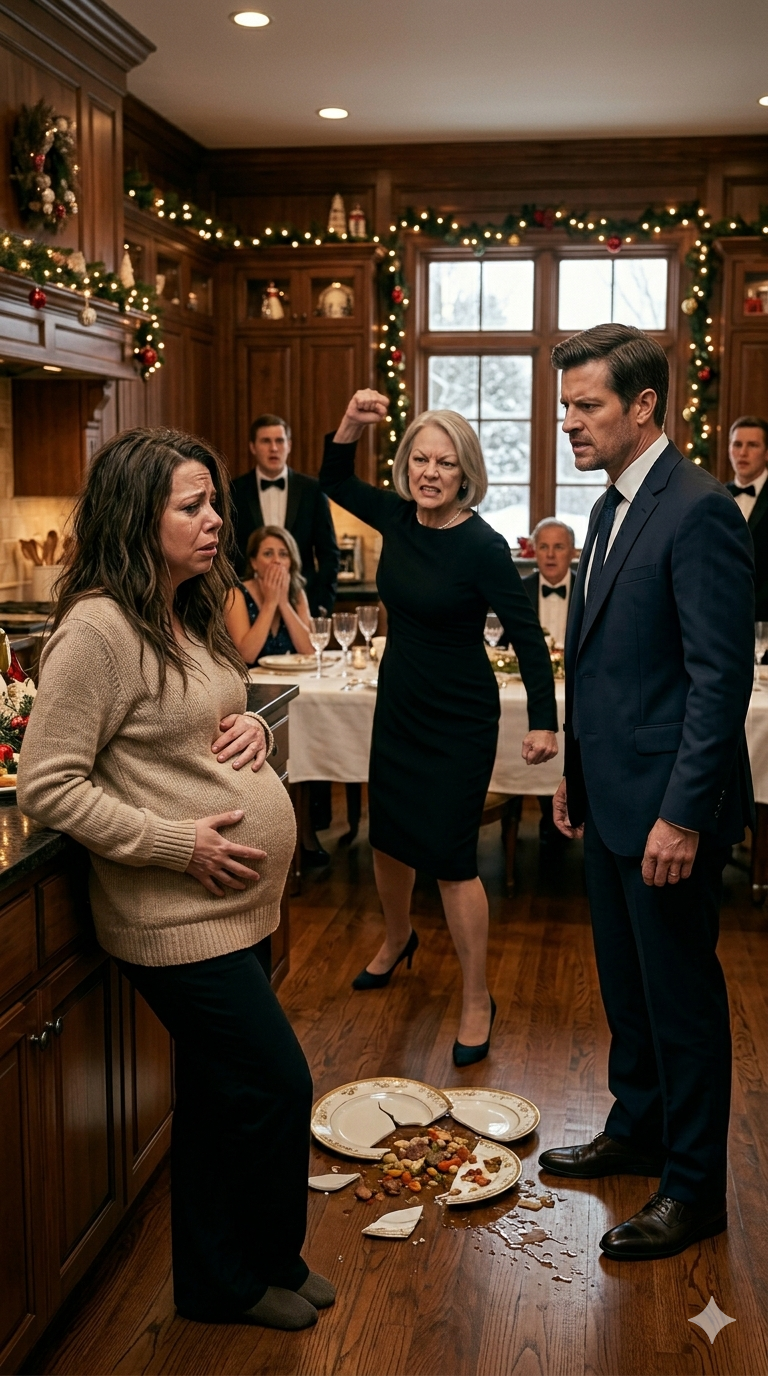
My hip slammed into the counter, the plate shattered on the floor, and a sharp, tearing pain ripped through my abdomen. Warm liquid ran down my legs. I grabbed the counter to keep from collapsing as Linda stared at me—not shocked, not sorry—just irritated. Ethan rushed in, saw the blood, and instead of calling for help, he took my phone from my hand when I reached for it.
“I’m a lawyer,” he said with a cold smile. “You won’t win.”
I looked straight at him, fighting to stay conscious, and said in a calm voice that made him hesitate:
“Then call my father.”
He laughed, unlocked my phone, and dialed the number I gave him, completely unaware that his life was about to split in two.
Ethan put the call on speaker, thinking humiliation would land harder with an audience. Linda crossed her arms. Richard stood near the doorway, pale but still silent, as if this were just another family issue that would pass if no one acknowledged it. I sank to the floor, one hand pressed beneath my stomach, the other braced against the cabinet as another wave of pain tore through me so sharply I could barely breathe.
The call connected on the second ring.
My father answered in the same steady, measured tone I had known my entire life. “Claire?”
Ethan smirked. “Mr. Bennett, I think your daughter is overreacting and—”
My father cut him off immediately. “Who is this?”
For the first time, Ethan hesitated. “This is Ethan Caldwell. Claire’s husband.”
There was a pause. Then my father’s voice shifted—not louder, but sharper. “Why are you calling from her phone? Put my daughter on.”
I swallowed hard and forced the words out. “Dad, I’m bleeding. Linda pushed me. Ethan took my phone. I need an ambulance.”
Everything that followed moved with terrifying speed.
My father didn’t repeat questions. He told me to stay awake, said help was already on the way, and instructed Ethan not to hang up. Ethan laughed again, but it sounded thinner now. He muttered something about misunderstandings, emotions, pregnancy stress. Then my father spoke one sentence that drained the color from Ethan’s face.
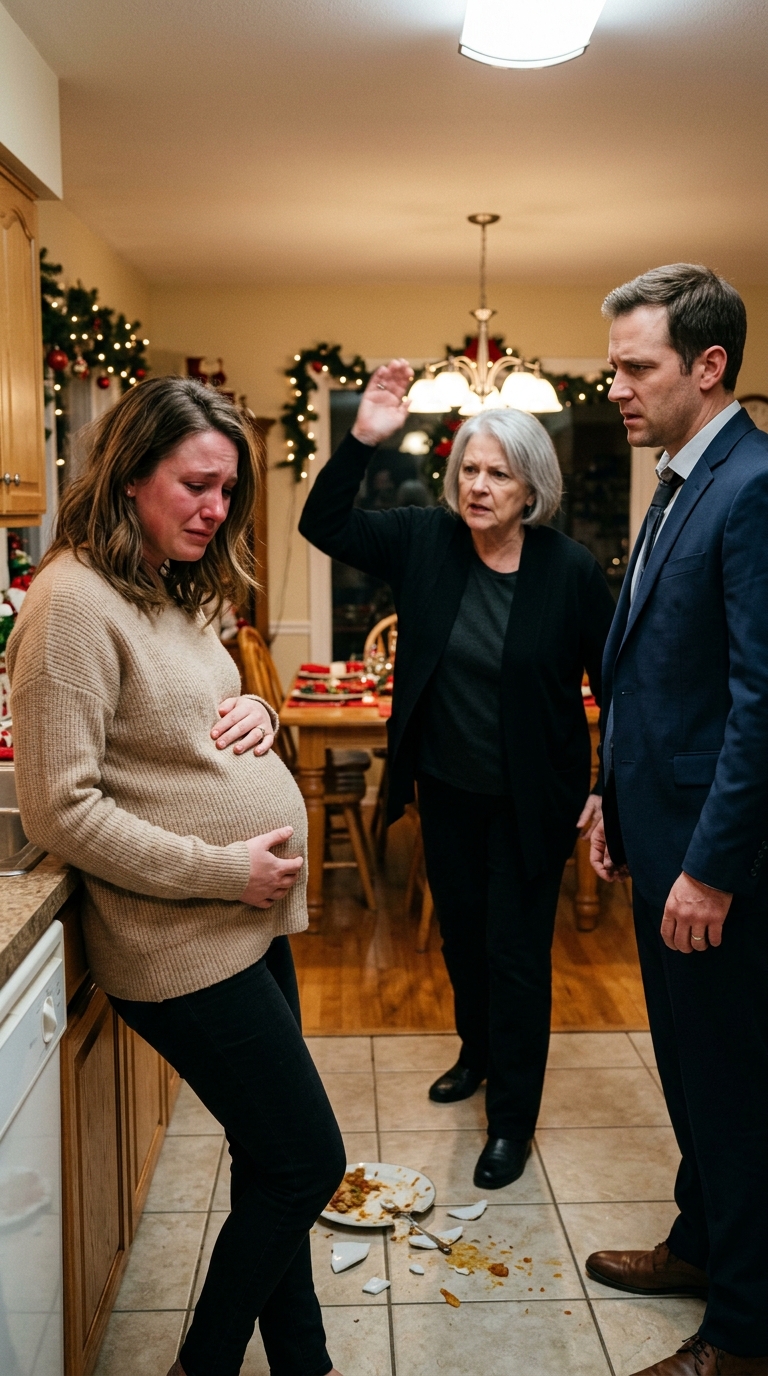
“Ethan Caldwell, you may understand courtroom procedure, but you clearly do not understand who you’ve just harmed through neglect and intimidation. I am Chief Justice Robert Bennett, and if my daughter or grandchild is harmed, every relevant authority will have this recording tonight.”
Linda actually stumbled backward. Richard whispered, “Oh my God.” Ethan ended the call, but it no longer mattered. My father had already heard enough.
Within ten minutes, paramedics arrived, followed by two police officers. Linda claimed I had slipped. Ethan framed it as a stressful family misunderstanding. But the blood on the kitchen floor, the shattered plate, my bruised hip, and the fact that I had asked for help in front of all of them told a clearer story than any polished argument could erase.
At the hospital, I learned I had suffered a placental injury and a partial miscarriage scare. The doctors stabilized me and saved the baby, but they were direct: if I had waited any longer, the outcome could have been devastating. My father arrived before dawn, still in his overcoat, with my mother beside him. He held my hand through every test, every form, every shaking hour, never once saying, “I told you so.” When I apologized for hiding my background from Ethan’s family, he simply said, “You wanted to be loved for yourself. That was never your mistake.”
By morning, the police had formal statements. The hospital social worker connected me with emergency protection resources. And Ethan—who once believed his law degree made him untouchable—began to learn that reputation collapses quickly when facts outweigh performance.
He started texting from unknown numbers—begging, apologizing, threatening, then begging again. But the story he had built about being the one in control was over. The law he had used to intimidate me was now waiting at his own door.
The weeks that followed blurred together—court filings, medical appointments, and a silence so heavy it felt physical. I moved into my parents’ guest house while I recovered. My mother filled the kitchen with simple food—crackers, soup, anything gentle enough to keep me steady. My father, despite the demands on him, checked on me every morning with coffee in one hand and a legal pad in the other. He never pushed. He just made sure I had facts, options, and protection.
The evidence against Ethan and Linda kept building. One of the responding officers had noticed a security camera above the Caldwells’ back entrance. A warrant later uncovered audio from the kitchen hallway. It didn’t capture the shove itself, but it recorded enough: my request to sit, Linda calling me weak, the crash of the plate, my cry of pain, and Ethan’s voice saying, with chilling clarity, “I’m a lawyer. You won’t win.” For a man who built his identity on precision, that sentence became the one thing he couldn’t explain away.
His firm placed him on immediate leave, then quietly cut ties. The bar association opened an ethics investigation—not only for the incident, but for interfering with an emergency call and attempting to intimidate me afterward. Linda was charged with assault. Richard, finally forced to choose between silence and truth, gave a statement confirming that she had blocked me from sitting and that Ethan had taken my phone while I was visibly bleeding. He cried as he signed it—which didn’t redeem him, but it mattered.
Three months later, I gave birth early but safely to a baby girl named Grace. When the nurse placed her in my arms—tiny, furious, alive—I felt something settle inside me that had been shaking for years. Surviving wasn’t the end of my story. It was the beginning of a different one. One where kindness wasn’t weakness, where education and family name meant nothing without character, and where love could no longer be confused with endurance.
My divorce was finalized the following year. I kept my last name. Ethan lost far more than his marriage. He lost the illusion that power belongs to whoever speaks with the most confidence. Real power, I learned, belongs to truth that holds under pressure.
I still think about that Christmas sometimes. Not because I miss any of it—but because I remember the exact moment fear left me. It was the second I stopped trying to survive their version of the story and started speaking my own out loud.
So that is mine.
And for anyone reading this in America who has ever been told to stay quiet for the sake of family, reputation, or appearances—don’t. Speak up. Tell the truth early. Tell it clearly. And if this story resonates with you, share your thoughts or your own experience—because sometimes the first step toward justice is realizing you’re not alone.
