Claire gave him the weary look of a woman who had already spent six months doing exactly that while her husband moved between time zones and boardrooms. “You’ll figure it out.”
He tried to hire a travel nanny. The agency sent someone perfect on paper—until she called in sick the morning of departure with food poisoning. There was no time to find a replacement.
So Andrew boarded a transatlantic flight with a six-month-old daughter, zero hands-on childcare experience, and a schedule packed with meetings that could impact thousands of employees.
For the first hour, he thought maybe it would be fine. Lily slept peacefully in the first-class bassinet while he reviewed contracts and financial reports. He even allowed himself a quiet moment of confidence. Maybe Claire had been right.
Then Lily woke up screaming.
He offered the bottle Claire had prepared. She turned away, crying harder. He changed her diaper in the cramped airplane bathroom, clumsy, sweating, and strangely embarrassed by how difficult something so simple felt. He walked the aisles, bounced her, shushed her, tried white noise, soft singing, firm pats, gentle rocking.
Nothing worked.
As time dragged on, the atmosphere in the cabin soured.
In seat 1A, Charles Winthrop, an older financier with a permanently dissatisfied expression, sighed loudly every few minutes, checked his watch, and shifted in exaggerated annoyance.
“This is why infants don’t belong in first class,” he muttered to his wife, just loud enough to be heard.
Across the aisle, socialite Vanessa Hale typed quickly on her phone and whispered to her assistant, “If you can’t handle a child, don’t bring one on an international flight.”
Andrew heard every word.
Under normal circumstances, these were the same people who would greet him warmly at charity events, praise his wife, ask about his business, and laugh too eagerly at his jokes. Now, stripped of status and comfort, they looked at him the way wealthy people often look at inconvenience—as if it were a personal failure.
But beneath the embarrassment was something deeper.
He was starting to realize he didn’t know how to comfort his own daughter.
He could analyze acquisitions, manage investors, and negotiate deals worth hundreds of millions across continents. Yet here he was, unable to soothe the one small person in the world who should have been able to rely on him completely.
Meanwhile, three rows back in economy, Noah Bennett had been listening.
At first, he tried to focus on his competition materials. His backpack held textbooks, problem sets, sharpened pencils, and the plane ticket his neighborhood had helped pay for. The International Mathematics Championship wasn’t just another contest—it was a chance at a full scholarship to MIT, a path forward, a way to change everything for himself and the people who believed in him.
Noah lived on the South Side of Chicago with his mother, grandmother, and three younger siblings in a small two-bedroom apartment. His mother, Denise, worked long hours as a nurse’s aide. His grandmother, Evelyn, took care of the younger kids while Noah studied. Money was tight, but effort never was.
Two years earlier, when his baby sister Ava was born, she had cried endlessly with severe colic. They couldn’t afford specialists or expensive treatments.
So Noah did what he always did when faced with a difficult problem.
He learned.
He read everything he could about infant digestion, colic, soothing techniques, and pressure points. He borrowed books, watched free videos, asked questions at clinics, and tested one method after another until something worked.
A specific hold. Steady pressure along the back. Less bouncing, more support. Humming instead of constant talking. Calm instead of frantic motion.
His grandmother liked to say he had “hands that listen.”
So while others heard only noise, Noah recognized a pattern—the kind of cry that suggested trapped gas, overstimulation, discomfort that hurried movement couldn’t fix.
For nearly two hours, he debated with himself.
He knew how it might look: a Black teenage boy from economy approaching first class, offering advice to a wealthy white businessman. He knew how often help from someone like him could be misunderstood as intrusion or disrespect. Experience had made him cautious.
But Lily kept crying.
Eventually, compassion won.
Noah stood, walked forward, and was stopped by a flight attendant near the curtain.
“Can I help you?” she asked carefully.
“The baby,” Noah said. “I think I can help.”
She looked at him skeptically. “Are you traveling with someone up here?”
“No, ma’am. But I’ve dealt with colic before. I recognize that kind of crying.”
She glanced toward first class, where Andrew stood in the aisle, holding a screaming baby, looking close to breaking.
Before she could respond, Andrew stepped forward. “Did someone say they could help?”
Noah took a breath.
“My name is Noah Bennett. I know I’m just a kid, but my little sister had severe colic. I learned some things that helped. Your daughter sounds like she might be dealing with the same thing.”
Andrew studied him for a brief but meaningful moment. He saw calm, focus, sincerity—no performance, no hesitation.
And because desperation leaves no room for pride, he listened.
“What kind of things?”
“A different hold. Gentle pressure along her back to relieve gas. And she might be overstimulated. Too much bouncing can make it worse.”
Andrew glanced around the cabin. Everyone was watching.
Then he made his choice.
“Please,” he said, handing Lily over.
What followed changed everything.
In Noah’s arms, Lily began to settle almost immediately. Her cries softened, then faded. He held her upright, supporting her carefully, applying small, rhythmic movements along her back. Then he started humming.
“What song is that?” Andrew asked quietly.
“My grandmother taught it to me,” Noah replied. “Her mother sang it to her.”
Lily let out one final sigh—and fell asleep.
Charles Winthrop, who had spent hours complaining, now stared in open amazement. “Remarkable,” he muttered.
Vanessa Hale lowered her phone. Even the flight attendants looked stunned.
Relief hit Andrew so suddenly it almost hurt. He sank into his seat as Noah gently adjusted Lily with the ease of someone who had learned through necessity, not theory.
“How long do you think she’ll sleep?” Andrew asked.
“If it was really colic and trapped gas, probably most of the flight,” Noah said. “She’s comfortable now.”
Andrew believed him instantly.
As Noah carefully handed Lily back, Andrew kept watching him.
“You said you’re going to London for a math competition?”
“Yes, sir.”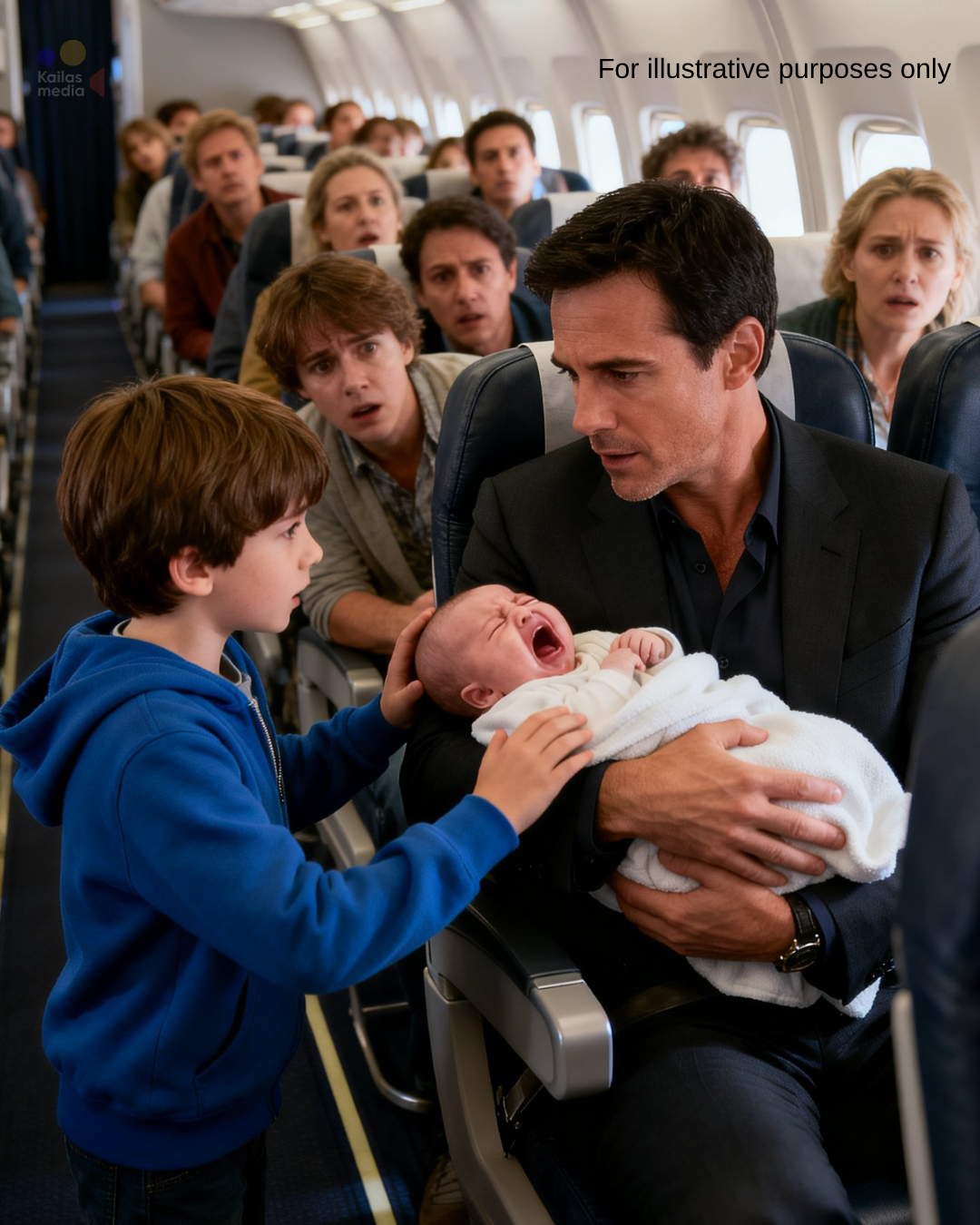
“Tell me about it.”
Noah explained—the International Mathematics Championship, the global competitors, the scholarships to MIT, Cambridge, Stanford. He had qualified through multiple levels.
“What are you strongest in?” Andrew asked.
“Number theory and combinatorics,” Noah said, with a small shrug. “I like difficult problems.”
Andrew smiled. “I can see that.”
Noah remained standing until Andrew gestured to the empty first-class seat across from him.
“Sit down. You’ve earned it.”
Noah hesitated, then sat carefully, as if crossing an invisible line.
Andrew asked about school.
Noah explained how his public school ran out of advanced math, so he taught himself. A teacher, Mrs. Alvarez, had first recognized his talent and guided him toward harder material. From there, he moved into college-level coursework using free resources and libraries.
“How did you afford this trip?” Andrew asked.
Noah shifted slightly. “My community helped. Church collections, fundraisers… people gave what they could.”
That answer stayed with Andrew.
This wasn’t just ambition—it was responsibility carried on behalf of others.
“What happens if you win?”
“Full scholarship. Living expenses. Opportunities.” Noah paused. “And I want to use it to help kids from places like mine.”
Andrew leaned back.
Over the next hour, as Lily slept peacefully, he found himself drawn not just to Noah’s intelligence, but to who he was. Someone who solved a human problem before talking about academic ones. Precise, grounded, ambitious—but still deeply aware of where he came from.
By the time the plane began its descent, Andrew had decided.
“I need to ask you something,” he said.
Noah turned to him.
“I’m in London for five days. I don’t have childcare. You’ve already proven you’re better with Lily than anyone I could’ve hired. I’d like to hire you to help while I’m there.”
Noah blinked.
“I’ll pay you five hundred dollars a day,” Andrew continued. “You’ll have your own room, transportation, and your competition comes first. I only need help around meetings and evenings.”
Noah stared. “Five hundred a day?”
“That’s what a travel nanny costs. And I trust you more.”
Noah didn’t look excited—he looked careful.
“Sir, I need to focus on the competition. This trip means everything.”
Andrew nodded. “And that stays the priority. But I’d also like to talk about something beyond these five days.”
Noah stayed quiet.
“My company funds students like you. No matter what happens, I want to support your education.”
For a moment, hope and caution crossed Noah’s face at the same time.
“Can I think about it?” he asked.
“Of course.”
By the time the plane landed at Heathrow, Noah had his answer.
“I’ll help with Lily,” he said. “And… thank you.”
Andrew smiled. “Good. We’ll sort everything out once we’re in the car.”
The difference between Noah’s everyday life and what awaited him outside Heathrow was so stark it almost didn’t feel real. A sleek black Mercedes stood ready at the curb. The driver opened the door, and the journey into central London unfolded inside a quiet cocoon of leather, polished wood, and effortless luxury.
As they drove, Andrew listened while Noah described the structure of the competition: an opening ceremony followed by three increasingly demanding rounds—individual proofs, team-based modeling, and a final presentation before a panel of judges.
“What do you think you’re strongest at?” Andrew asked.
“Pressure rounds,” Noah replied. “I stay clear when things get difficult.”
Andrew didn’t doubt it.
At the Langham Hotel, Noah tried not to stare. Marble floors, towering chandeliers, fresh flowers everywhere, and staff who moved with quiet precision—it all felt like stepping into a world he had only ever seen from the outside.
Andrew’s suite occupied a corner on the top floor, with multiple rooms and sweeping views of the city. Noah’s adjoining room alone was larger than his family’s living room back in Chicago, with a bed too pristine to touch and a bathroom lined in pale stone.
“This is… a lot,” Noah said under his breath.
“It’s just a hotel room,” Andrew replied casually, bouncing a now-content Lily in his arms. “Try not to let it offend you by being impressed.”
Noah couldn’t help but smile.
Later, after Lily had been fed and drifted to sleep, Noah finally asked what had been on his mind.
“Why are you doing this? You don’t even know me.”
Andrew stood in the kitchenette, warming another bottle. He answered without looking up at first.
“Because I recognize talent when I see it. And what you did on that plane wasn’t just kindness. It was judgment under pressure. Pattern recognition. Calm. Confidence. Compassion. Most people have one or two of those. You had all of them.”
Then he met Noah’s eyes.
“And because I know what it’s like to need someone to open a door.”
That night, Andrew told him the truth about his past—growing up with a factory worker father, a mother who cleaned offices, earning scholarships, always being the smartest in the room but rarely the richest. He had built everything from almost nothing, and he hadn’t forgotten what it felt like to be overlooked.
Something shifted inside Noah.
The next morning, the competition began.
At the Royal Institution, Noah walked into a room filled with students from around the world. Some wore tailored blazers and arrived with mentors and teams. Others, like him, carried quiet determination and little else.
The first round was individual problem-solving. Four hours of deep thinking—proofs, patterns, structures.
As soon as Noah opened the booklet, he felt it—the familiar spark. A difficult problem revealing its hidden shape. Number theory. Combinatorics. Even a deceptively complex geometry problem waiting to be unraveled.
He worked steadily, losing track of time.
When he returned to the hotel, exhausted but hopeful, Andrew was just finishing a call.
“How was it?” he asked.
“I think… good,” Noah said. “Maybe really good.”
Andrew nodded toward Lily, who was happily stacking cups on the carpet. “Perfect. Because I need those miracle hands again.”
What surprised Noah most was how natural everything began to feel. Competition during the day. Helping with Lily during Andrew’s meetings. Studying in the evenings. Occasional conversations about business, math, life, and opportunity.
Taking care of Lily calmed him. He counted blocks with her, arranged toys into patterns, laughed when she knocked them over.
One day, Andrew watched from the doorway and joked, “You teaching math to babies now?”
“Start early,” Noah replied.
On the second day, the competition shifted to teamwork. Noah worked with students from Japan, Germany, and Brazil. At first, he worried he might fall behind.
Instead, he became the connection between them.
When tasked with modeling urban traffic systems, the others focused purely on theory. Noah pushed them to think about real-life variables—human behavior, weather, emergencies, unpredictability.
“You can’t optimize just for equations,” he said. “You have to optimize for people.”
That insight changed everything—and put their team near the top.
By evening, the others no longer saw him as the underfunded kid from Chicago, but as someone whose thinking brought something different—something essential.
That night, after Lily had fallen asleep, Andrew sat with Noah, the city lights stretching out below them.
“I want to tell you something before tomorrow,” he said.
Noah looked up.
“No matter what happens, I want to offer you something beyond a scholarship.”
Noah stayed silent.
“I want to fund your education—all the way through graduate school, if that’s what you choose. And after that, I want you at my company.”
Noah blinked, stunned.
“Not charity,” Andrew continued. “Investment. I want to build something that actually solves real problems—education gaps, healthcare inequality, infrastructure. You understand both the math and the reality behind it. That’s rare.”
Noah took a breath. “That’s… a lot.”
“It is.”
“I’m only sixteen.”
Andrew smiled slightly. “You won’t stay sixteen.”
That made Noah laugh despite everything.
“Think of it this way,” Andrew added. “I’d rather recognize your value now than watch someone else do it later.”
The final day arrived.
Noah’s last challenge was an individual presentation on a real-world problem: modeling disease spread in dense urban communities and designing a prevention system.
It was exactly what he loved—mathematics connected to real life.
He drew from everything he knew: probability, network theory, public health data, and the lived reality of neighborhoods where small problems could quickly become disasters.
When he presented, he spoke simply, clearly—not to impress, but to build something useful.
One judge asked, “How did you develop such a practical model?”
Noah answered honestly. “Because where I come from, problems like this aren’t theoretical.”
The judges exchanged glances. They knew they were seeing something special.
That evening, at the awards ceremony, Noah sat still as the results were announced.
Third place.
Second place.
His heart pounded.
“And this year’s champion… Noah Bennett, from Chicago, Illinois.”
For a moment, he didn’t move.
Then the room erupted.
He walked to the stage in a daze—trophy in hand, full scholarship secured, cameras flashing, applause echoing.
From the stage, he spotted Andrew standing, clapping without restraint, holding Lily, who bounced happily in his arms as if she understood everything.
Later, back at the hotel, they celebrated quietly—sparkling cider, late dinner, Lily laughing as she banged a spoon against a toy.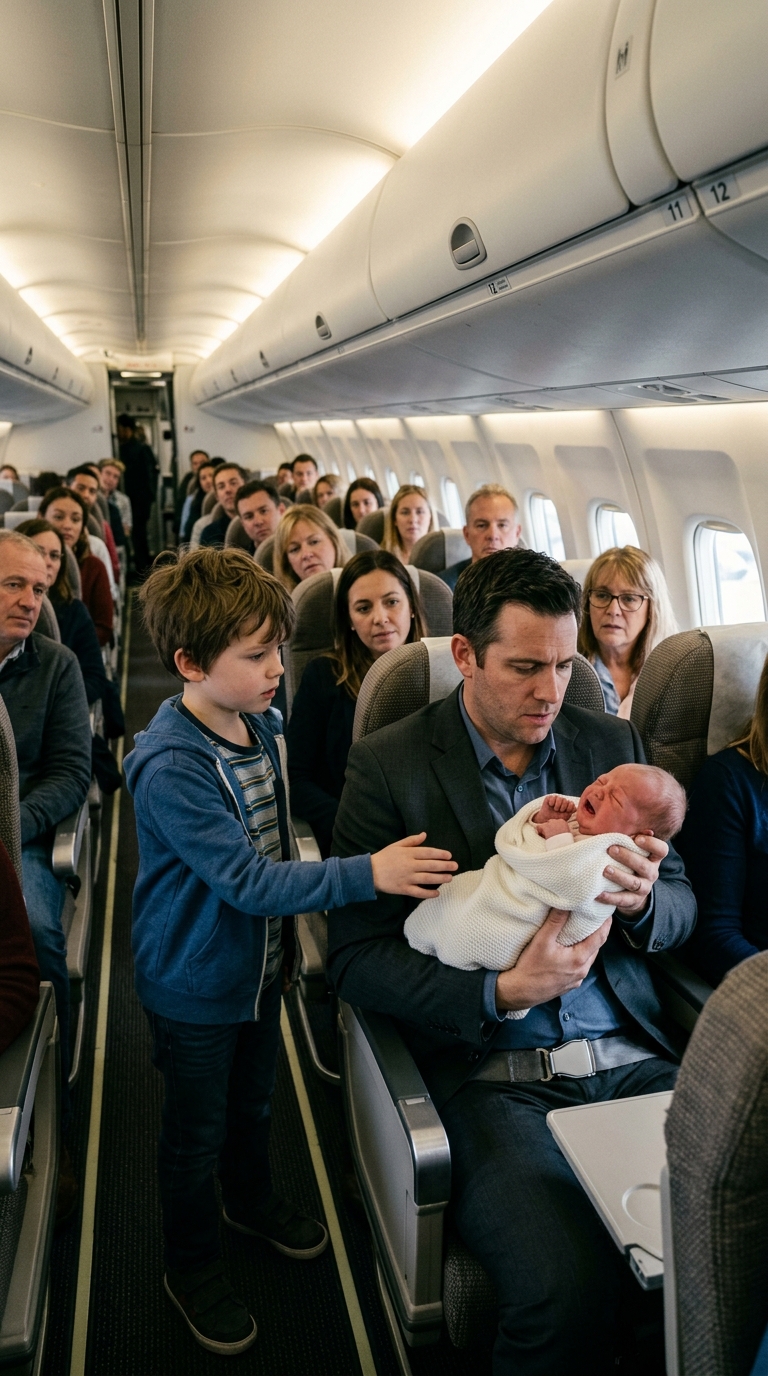
“You know,” Noah said, lifting her, “this all started because she wouldn’t stop crying.”
Andrew smiled. “And because you stood up.”
Noah looked down at Lily. “I almost didn’t.”
“I’m glad you did.”
Andrew raised his glass. “To impossible flights.”
Noah raised his. “To difficult problems.”
They clinked them together.
On the flight home, something had changed. They didn’t need to define it. It was more than gratitude—something steadier. Mentor and student. Maybe even future partners.
Because talent alone isn’t enough.
It has to be seen. Supported. Given space to grow.
As the plane crossed the Atlantic, Noah thought about how close he had come to staying in his seat. How easy it would’ve been to do nothing.
But he hadn’t.
He had chosen to act.
And because of that, everything changed.
He won the competition. Secured his future. Found someone who believed in him at the exact moment he was ready.
Andrew, holding his sleeping daughter, understood something too.
Success can teach you many things.
But not everything.
Intelligence matters. Discipline matters.
But character—that’s what turns ability into something meaningful.
And sometimes, the most important person on a plane isn’t the CEO in first class…
…but the kid in economy who decides to stand up.
By the time they landed, both of them knew this wasn’t just a coincidence.
It was the beginning of something neither of them could have reached alone.