

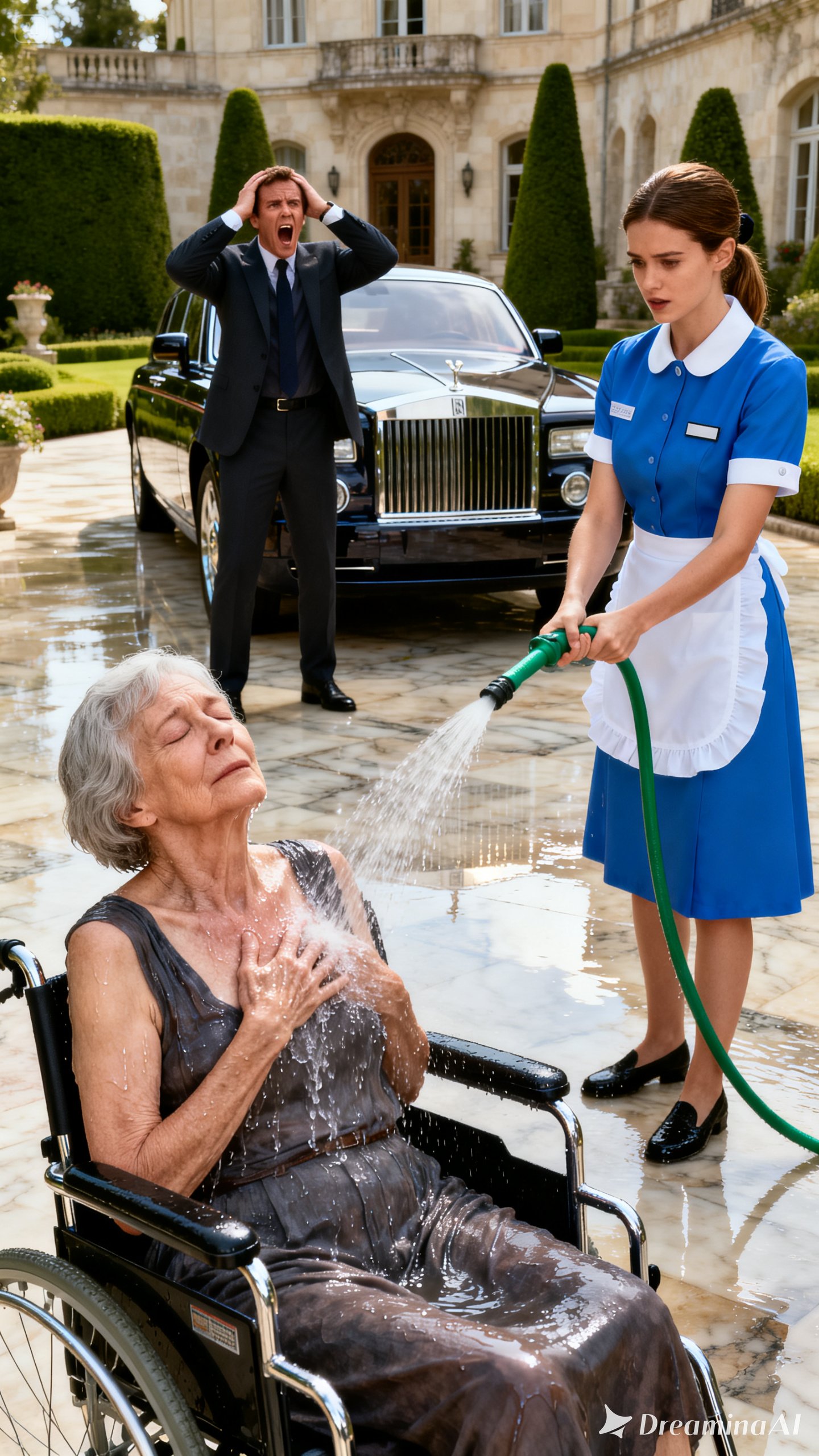
At six in the evening, as the Texas sun bathed the limestone walls in amber light, Daniel Whitmore stopped in his tracks at the gates of his estate, pressing his fingers to his temples as if reality itself had just cracked open.
It wasn’t the luxury sedan in the driveway.
It wasn’t the flawless lawn or the perfectly trimmed roses.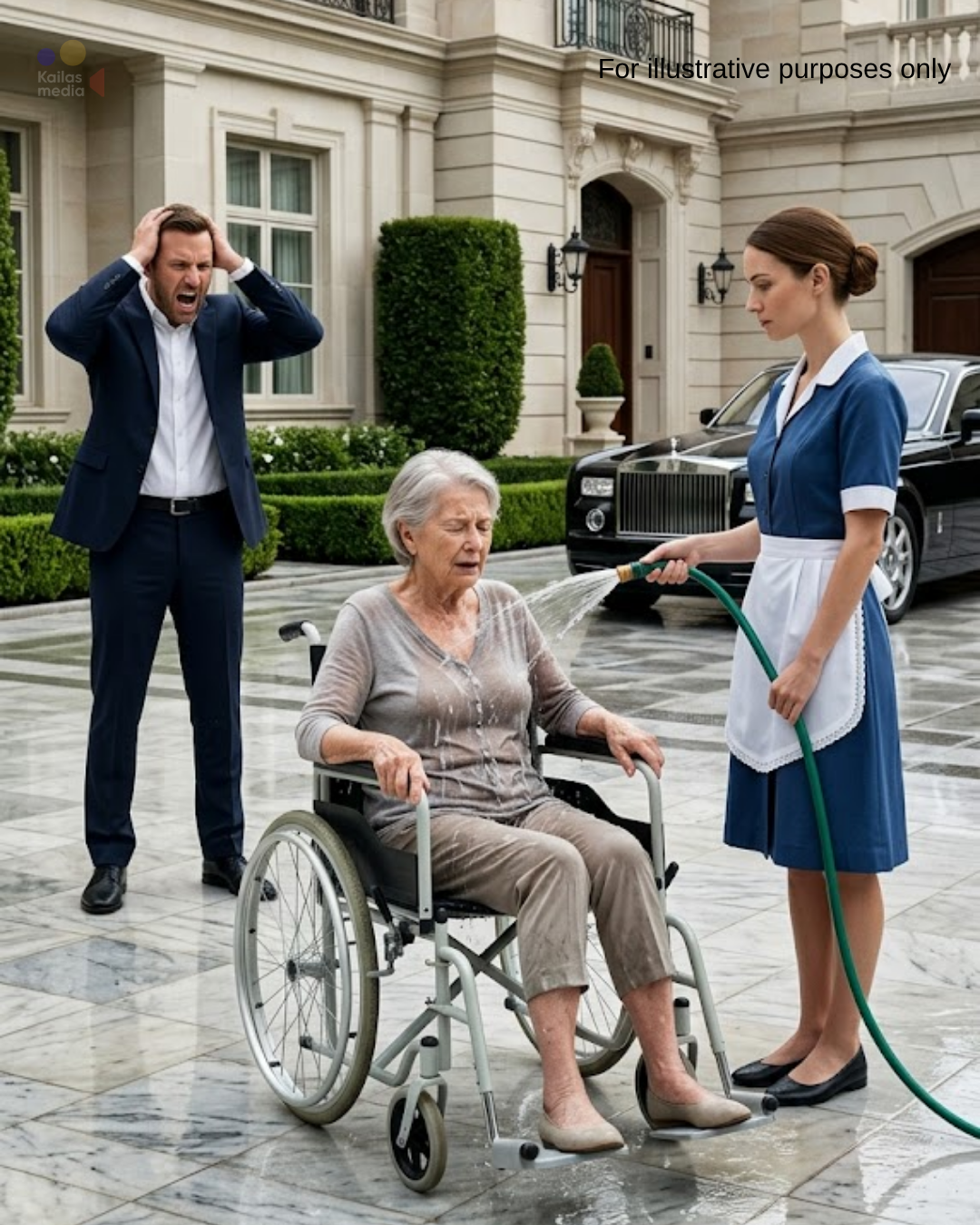
It was what was unfolding right in front of him.
His mother, Eleanor Whitmore, seventy-seven, sat upright in her wheelchair, dignified as always. Her white hair was neatly pinned, her posture composed, her expression serene in the way only someone who has endured a lifetime of hardship can be.
Standing beside her was Rachel, the new housekeeper. Young, slender, dressed in black with a spotless white apron—and holding a garden hose.
And impossibly, unbelievably, Rachel was pouring water directly over Eleanor’s head.
Water ran through Eleanor’s silver hair, soaked her sweater, and dripped onto the grass like a sudden downpour.
“What are you doing?!” Daniel shouted, rushing forward.
Rachel didn’t flinch. She didn’t lower the hose.
“I’m bathing your mother,” she said evenly. “And when I’m done, she’s going to stand.”
Daniel’s face flushed with anger.
“You’re out of your mind!” he snapped, reaching for the hose. “My mother hasn’t walked in twelve years. She’s paralyzed. You think cold water is some miracle cure?”
Rachel held her ground, her eyes calm, unsettlingly certain.
“You spent millions on doctors,” she said. “They treated her body. No one treated her will.”
Daniel let out a sharp laugh. “I brought specialists from Europe. Neurologists, experimental treatments—things not even approved yet. Every one of them said the same thing. Permanent damage. No recovery.”
Rachel lowered the water flow slightly and asked quietly, “When was the last full evaluation?”
Daniel hesitated.
“Six… maybe seven years ago.”
Rachel nodded slowly. “So no one ever checked again. You accepted the diagnosis from the beginning and closed the door.”
“I didn’t abandon her!” Daniel snapped. “She has the best chair, nurses, caregivers—comfort.”
“Yes,” Rachel replied. “Comfort. No resistance. No challenge. No reason for her nerves to wake up.”
Before Daniel could answer, Eleanor spoke softly. “Daniel… let her finish.”
That frightened him more than anything.
Rachel knelt. “Mrs. Whitmore, when they bathe you, is the water warm?”
“Always,” Eleanor replied.
“And are they gentle with your legs?”
“Yes.”
“That’s the problem,” Rachel said, turning the tap open again. “Warm water teaches the body to sleep. Cold demands attention.”
Without asking, she sprayed Eleanor’s legs through the fabric.
Eleanor stiffened, her eyes squeezing shut.
“Tell me what you feel,” Rachel urged. “Not what you expect. What you feel.”
Long seconds passed.
“I… feel something,” Eleanor whispered. “Like pins… faint electricity.”
Daniel’s breath caught. “Mom?”
“I thought it was nothing,” Eleanor admitted. “I was afraid to hope.”
Rachel turned off the hose and took Daniel’s hand, placing it firmly above Eleanor’s knee.
“Press hard.”
“I’ll hurt her.”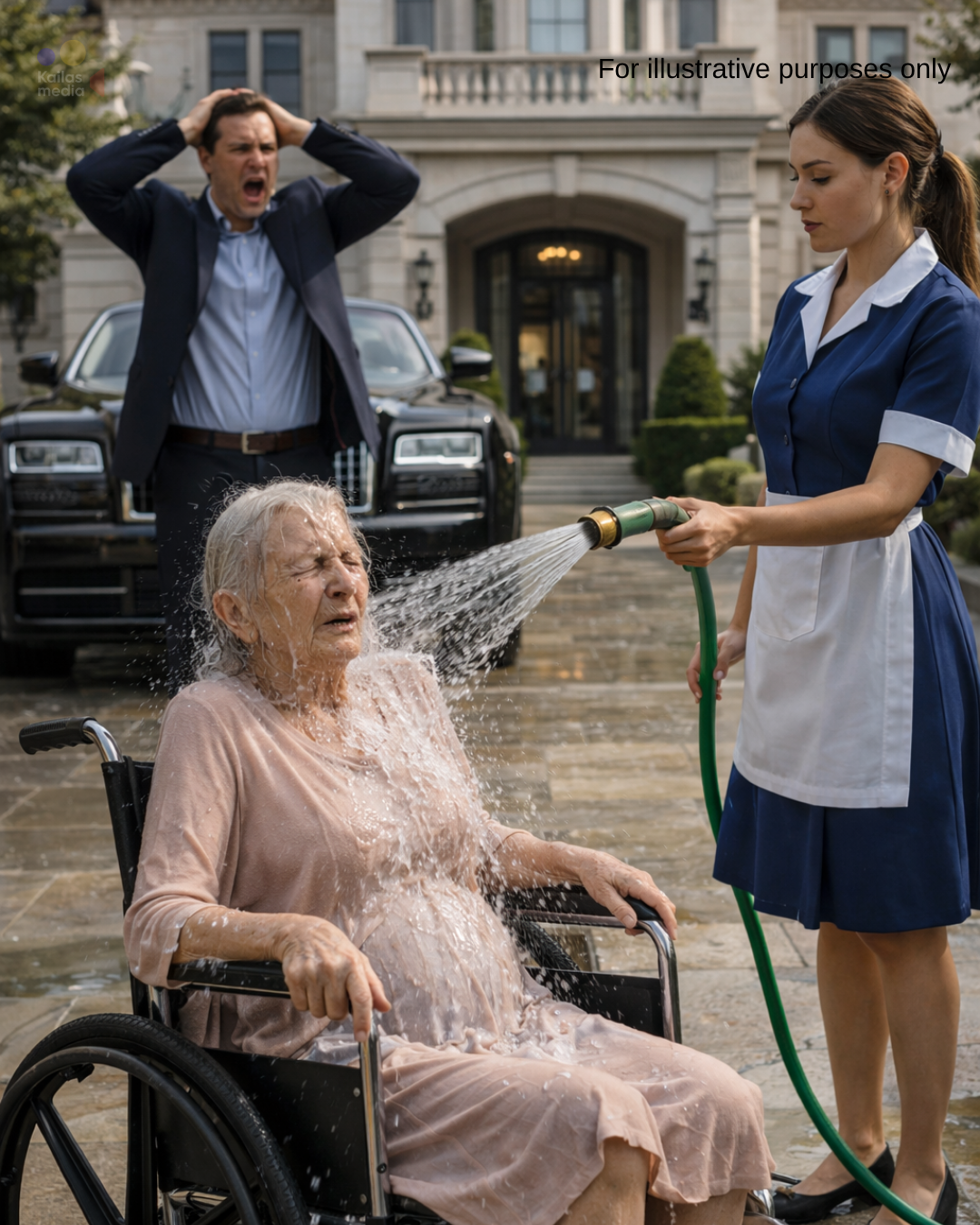
“You’ve avoided pain for twelve years,” Rachel said. “Press.”
He did.
Eleanor gasped. “I felt it!”
Daniel dropped to his knees, sobbing openly.
“I wanted to protect you,” he whispered.
“You protected me into silence,” Eleanor said gently. “I chose safety. I shouldn’t have.”
Rachel extended her hands. “On three. Not because you’re sure. Because you’re willing.”
“What if I can’t?” Eleanor asked.
“Then we try again tomorrow,” Rachel said. “And the next day.”
“One,” Rachel counted.
“Two.”
“Three.”
Eleanor pushed. Her arms trembled. Her face tightened with effort.
Her body lifted—just barely—but undeniably off the chair.
Three centimeters.
Against twelve years.
She fell back, crying, laughing, breathless. “I did it.”
“Again,” Rachel said immediately.
Eight seconds. Fifteen.
Thirty—this time Rachel only holding her hands.
As dusk settled and the grass darkened beneath them, Rachel said, “One step.”
Daniel panicked. “That’s too much.”
“No,” Eleanor said, fierce and shaking. “I’m ready.”
She stood, her legs trembling like branches, lifted one foot, then the other.
Three steps.
Then she collapsed forward—and Rachel caught her.
They laughed and cried together while Daniel wrapped his arms around them, shaking.
“How did you know?” he asked.
Rachel wiped her eyes. “Because I was in a wheelchair too. Seven years ago. They said it was permanent.”
Eleanor looked at her in disbelief.
“A therapist woke me up,” Rachel said. “He said I wasn’t broken. Just asleep.”
Four months later, Eleanor walked into Daniel’s office with a cane, standing tall.
“I wasn’t gone,” she smiled. “I just forgot I was alive.”
That week, Daniel rewrote Rachel’s contract: rehabilitation specialist, full support, respect.
And every Sunday, among the roses, Eleanor walked a little farther—while Daniel watched, grateful that someone had dared to say:
“Not yet. Don’t give up.”
